10.6.06

El cierre de este blog

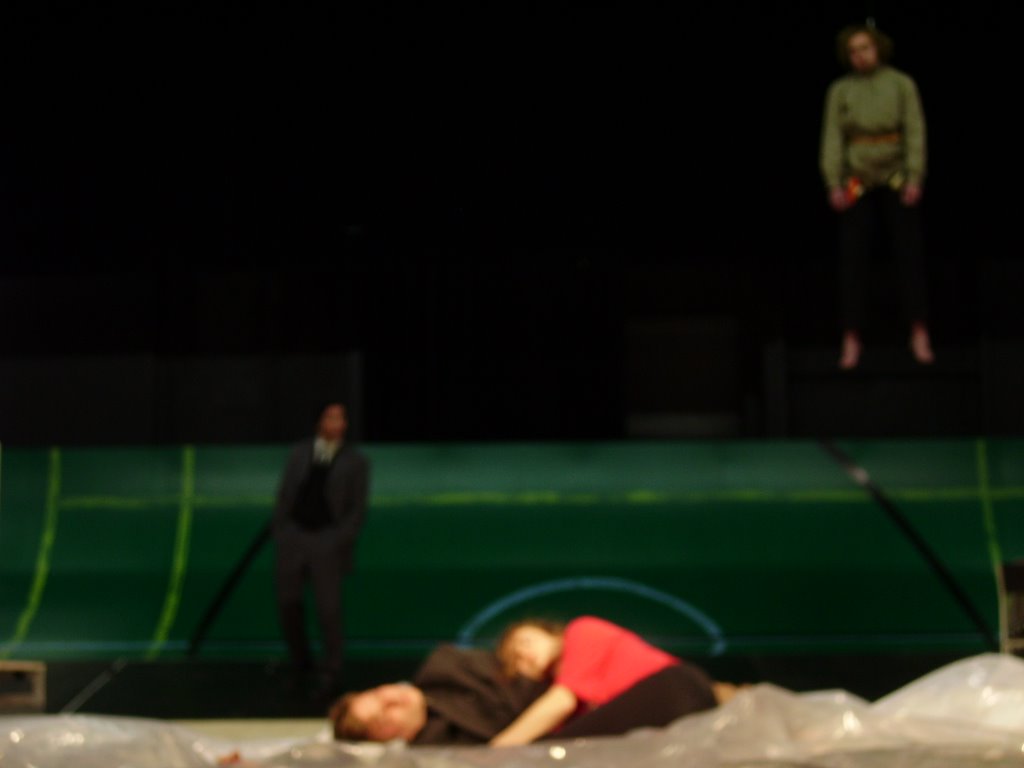
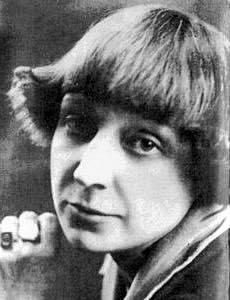
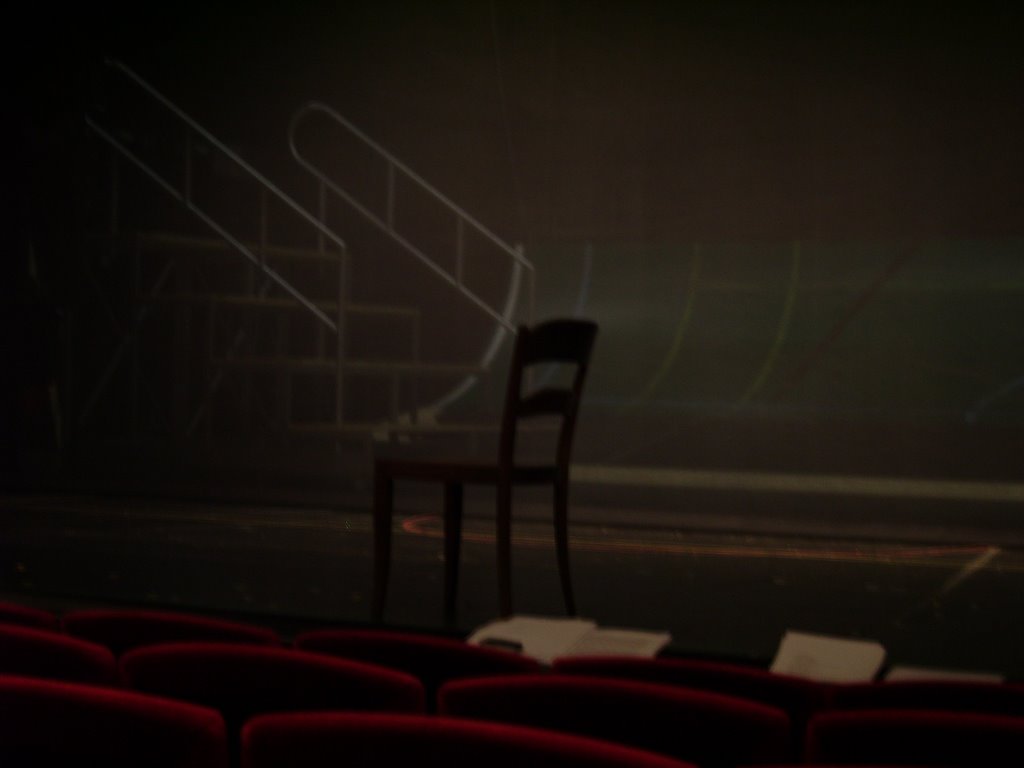
Esta es la silla de Marina Tsvietáieva.

Y fue el final: - el pasado jueves 8 de junio - R&J ofreció su última función en Lucerna. Este post - entonces - despide este blog.

Pueden visitar algunos blogs que siguen su carrera - todavía: el de Los Mansos, el de Cuchillos en gallinas y el Karamazov!

Gracias por haberme acompañado hasta acá.

Alejandro Tantanian

23.1.06

The last performance / La última función

Jürgen Sarkiss frente a sus zapatos transformado en el Leiermann.

Romeo & Julia say goodbye
!!
08.06.2006
at 19.30 / a las 19.30

R&J

Una versión moderna de 'Romeo y Julieta'

La obra más famosa de Shakespeare se estrena este viernes, 13 de enero, en el Teatro de Lucerna, bajo la dirección del dramaturgo y actor argentino Alejandro Tantanian.
Sin balcones ni callejuelas veronesas, la idea del 'suicidio' adquiere un protagonismo que relega el amor a un segundo plano.


Alejandro Tantanian es el responsable de un libreto bastante poco tradicional, que se atreve a releer y a recrear una de las historias de amor y suicidio más famosas de la literatura universal.

El joven director apostó siempre por trabajar sobre clásicos, jugando con la premisa de que cuando se trata de obras muy conocidas, ni el espectador ni el lector necesitan de un andamiaje 'ad hoc' para encontrarse con el texto o con el espectáculo, y se jugó a ambientar su 'Romeo y Julieta' en una cancha de básquet, desafiando cualquier espíritu conservador.

swissinfo conversó con el prestigioso artista, quien se encuentra haciendo los últimos ajustes a la puesta en escena que en pocos días saldrá a la luz en la ciudad de Lucerna.

"Llegué a Suiza invitado por Peter Carp, el director de la parte de teatro, quien está hace un año y medio dirigiendo el Teatro de Lucerna, y con quien fuimos compañeros hace unos años en una beca de la Academia de Stuttgart, en Alemania", comienza relatando Tantanian.

El dramaturgo explica que la puesta es con actores alemanes y suizos que conforman el elenco estable del teatro, y lo acompañan asistentes argentinos y una traductora que cumple un importante papel para ayudar a optimizar el trabajo en conjunto, ya que toda la preparación de la obra se maneja en inglés:

"Yo me manejo en inglés y diría que el 80 por ciento de los actores, que son todos de habla alemana, entienden muy bien el idioma, y la traductora –que siempre es necesaria- ayuda muchas veces a comprender mejor las directivas del inglés al alemán"
Alejandro Tantanian. (Foto: Gentileza de Alejandro Tantanian)
¿Una cancha de básquet?
La idea de usar una cancha de básquet como escenario único surgió del argentino Jorge Macchi, a cargo de la dirección de escenografía, quien había visto una foto de refugiados del tsunami en una pista de baloncesto y de allí tomó el diseño espacial.

Tantanian apunta que trabaja bajo el supuesto de que el público ya conoce la obra y utiliza el material para otro desarrollo que escapa a la tradicional representación de 'Romeo y Julieta'.

"Pensé partir de lo que 'Romeo y Julieta' significa para cada actor, lo que significó en su vida y en su carrera, cómo se acercó cada uno a ella por primera vez", sostiene el director.

"La idea es tratar de desviar el sentido único que tiene la obra, sobre todo por la gran tradición que existe sobre ella. Quería que la gente pudiera pensar el material sin atarse a balcones ni a callecitas de Verona", agrega.

"Digamos que la idea, el punto de partida, es que los actores están en un sitio del que no pueden salir porque algo afuera es amenazante. Desde ese lugar es que comienzan a contar historias, un poco como en el 'Decamerón'".

"Así se va armando el argumento que se impone en esa noche, hasta que en el final no se sabe si los que mueren son los personajes o esos actores que cuentan sobre los personajes"

A lo largo de la historia, comienza a descubrirse una vocación suicida de todo el grupo de gente que se encuentra refugiado en la cancha de básquet, y la tragedia shakespeariana contamina el espacio.

"A partir del juego de 'Romeo y Julieta', los protagonistas empiezan a construir vínculos que tienen que ver directamente con el suicidio que la obra plantea".

"No olvidemos que Romeo y Julieta' es una exaltación del suicidio amoroso. Ellos pueden unirse únicamente en la muerte, por eso la última escena de este clásico se da en una tumba. Es una especie de 'necrofilia' romántica", puntualiza Tantanian.
¿Qué verán? Los amores que matan...
Tantanian asegura que quienes vayan a ver la obra se encontrarán con una mirada diferente sobre la obra de Shakespeare. Hasta ahora, asegura, se ha dado un enfoque más psicologista, donde los padres separaban a los amantes por egoísmos, y se perdió el auténtico foco de la obra, que es una especie de 'celebración de la muerte':

"Obviamente la historia de amor está claramente reflejada. Pero en esta versión hay un énfasis más vinculado a la muerte que el amor. La obra es una celebración de ambas cosas: Romeo y Julieta pueden estar únicamente unidos, a través del amor, en la muerte. Y es así que el cuerpo, lo carnal, juegan un rol más fuerte, dejando de lado lo más platónico".

Basado en textos de varios suicidas conocidos (Alejandra Pizarnik, John Donne, Heinrich von Kleist, Silvia Plath, Paul Celan), Tantanian revisa los mitos a través de los cuales se piensa la muerte y el amor con un discurso predeterminado, y los confronta con el suicidio como voluntad.


swissinfo, Norma Domínguez, Buenos Aires

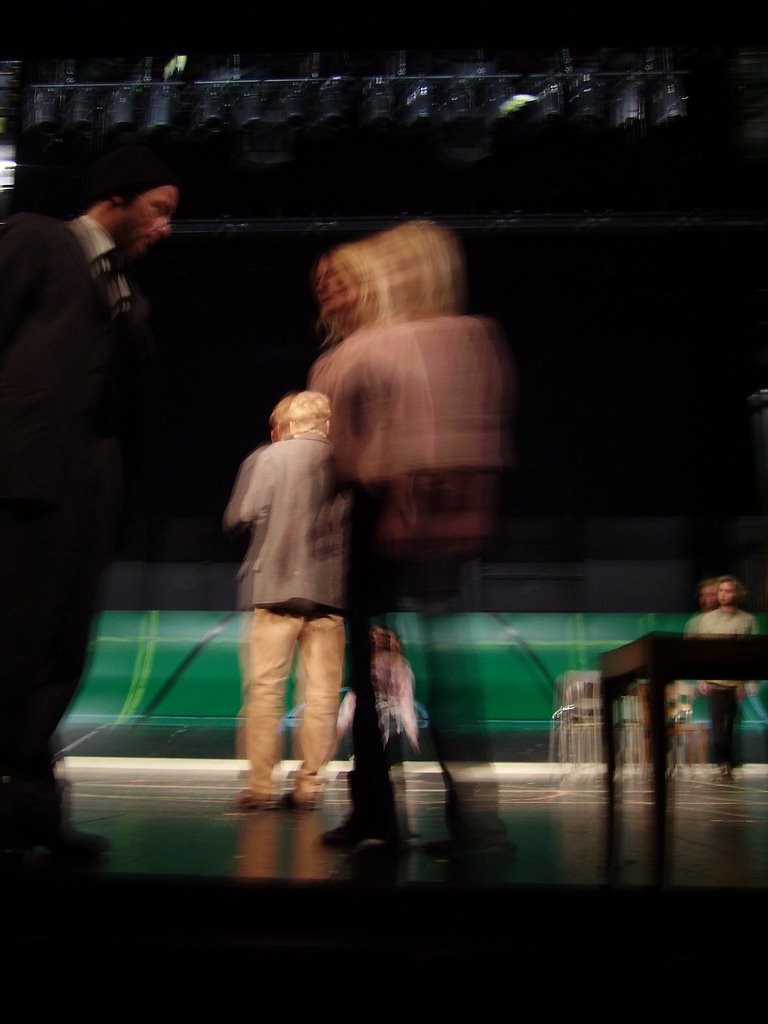
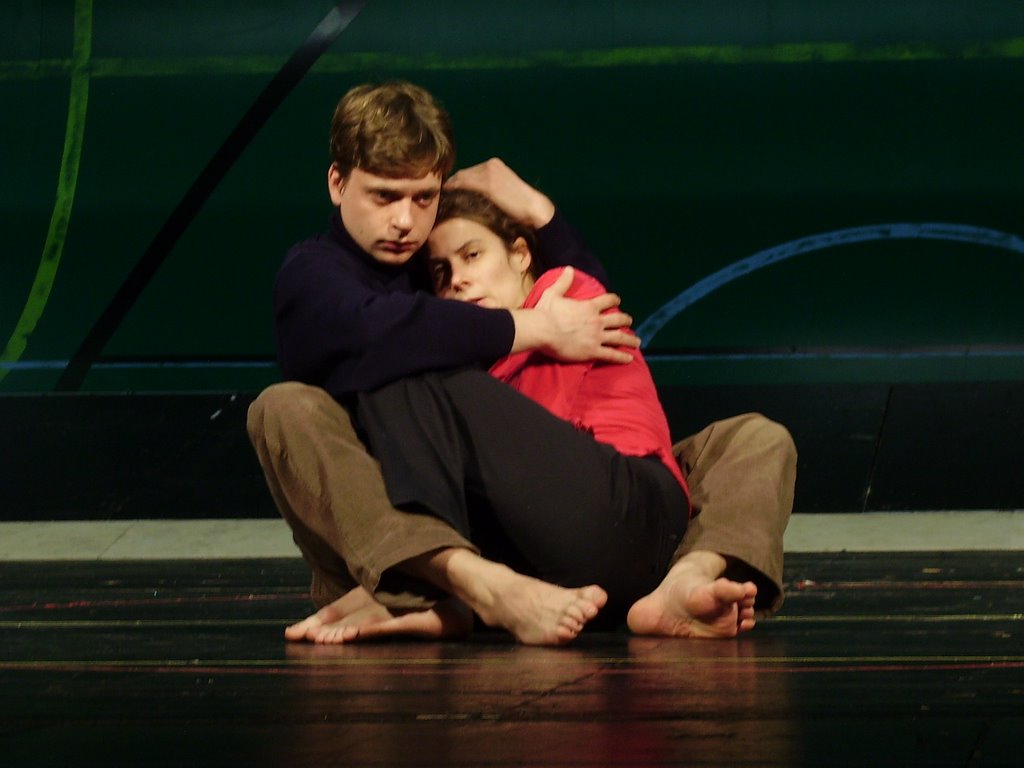
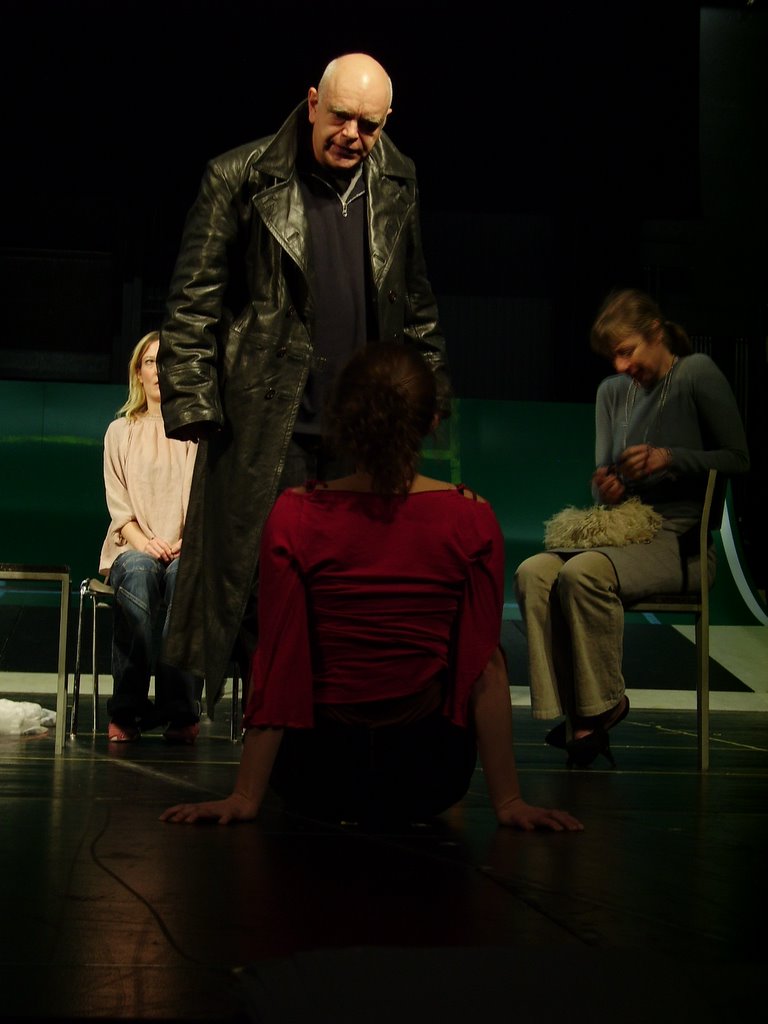
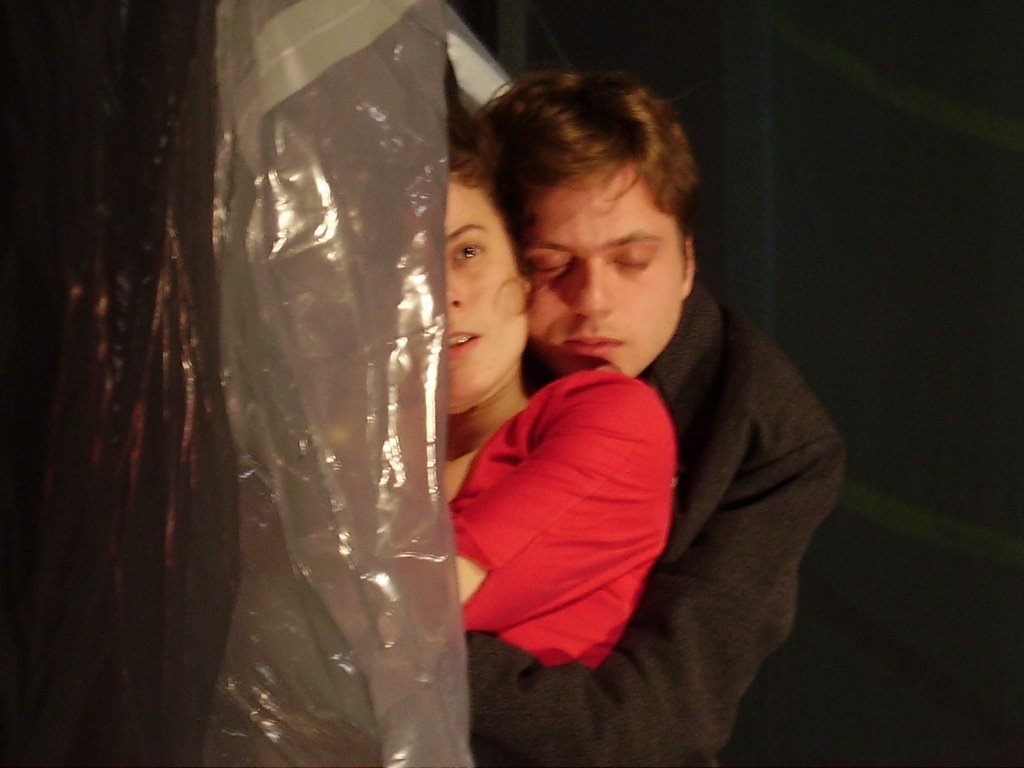
Algunas fotos

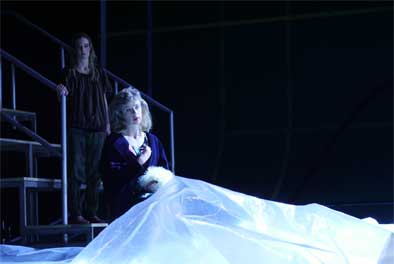
Anna Stieblich (Lady Capulet) evoca a Sylvia Plath. Detrás Anja Schweitzer (Amme) descubre el horror.


Una silla vacía: emblema de este R&J. Detrás de la silla los amigos de Romeo (Roland Bonjour, Martina Potratz y Peter Waros) y Romeo (Philippe Graber) esperan la pelea.


Jürgen Sarkiss (Tybalt) detrás de la silla sin dueño provoca la pelea. Detrás Henry Meyer (Friar Laurence) calcula su próximo movimiento mientras el DJ Christoph Gerega (Paris) anima la fiesta con sus vinilos.


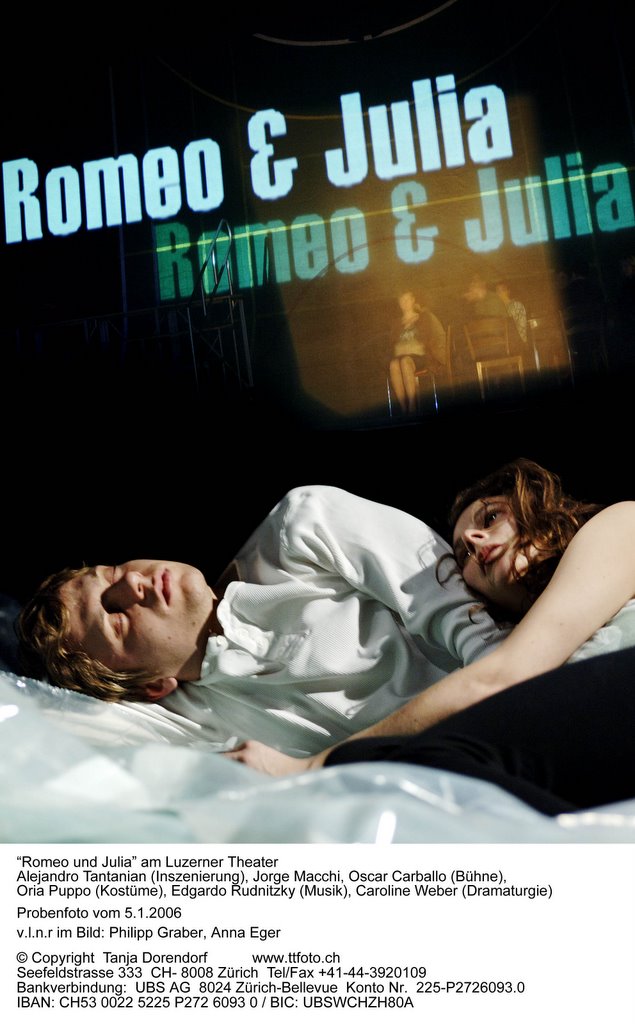
Philippe Graber (Romeo) busca a su Julia (Anna Eger) en la gran tumba.


Jürgen Sarkiss a punto de matar a alguien.


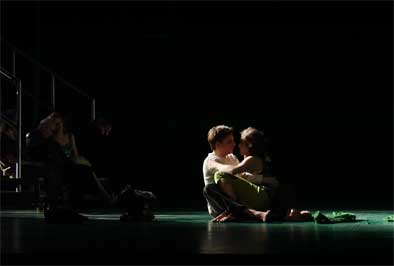
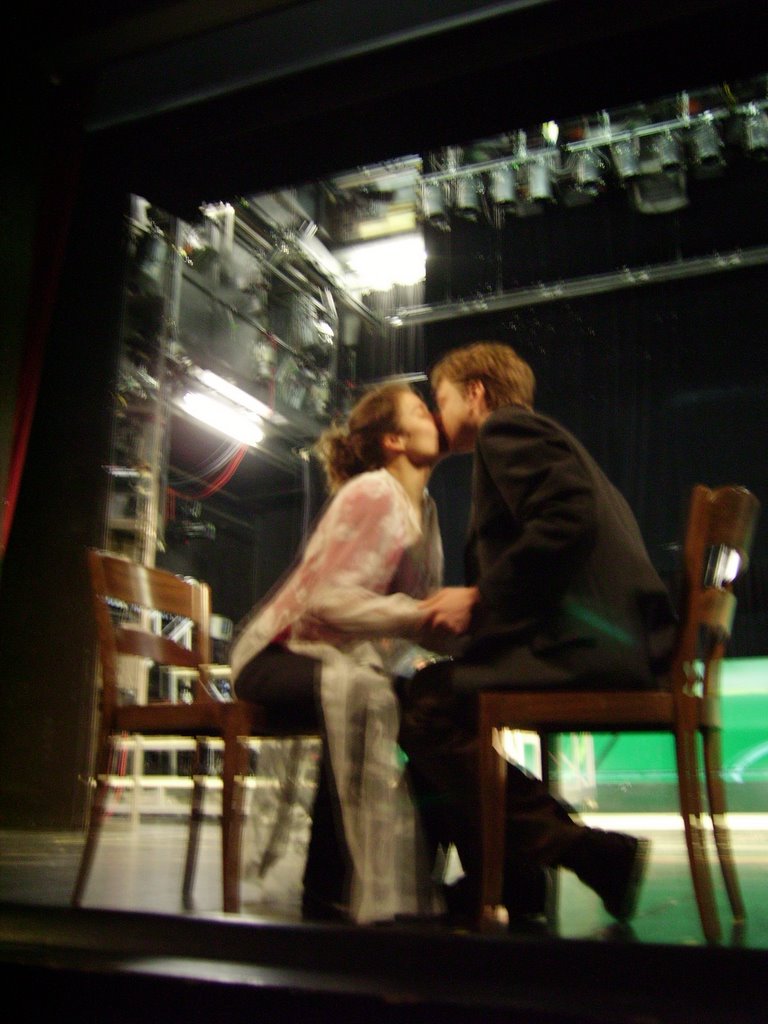
Romeo y Julia se despiden mientras las cajas de música hacen lo suyo. En sombras Christoph Künzler apoya la cabeza sobre el hombro de Anna Stieblich (Lord y Lady Capulet).

7.1.06

A weektime for the premiere / Una semana para el estreno

31.12.05

La silla de Marina / Marina's chair


Yo no respeto el teatro. No me interesa y no tengo ninguna consideración con él. El teatro (ver con los ojos) me ha parecido siempre una actividad para los pobres de espíritu, una garantía para los astutos pertenecientes a la raza de Tomás el incrédulo, que no creen en lo que ven - y aún más - en aquello que sienten. Una especie de alfabeto para los ciegos.

Marina Tsvietáieva
Dos palabras sobre el teatro


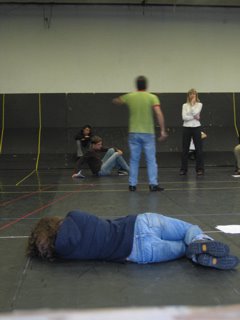
Algunas fotos del ensayo de hoy / Some pictures from today's rehearsal

El rostro de Paris es un libro / Paris's face is a book
Philippe Graber, Peter Waros, Anna Stieblich, Anna Eger & Anja Schweitzer


Una canción para Rosalinda / A song for Rosalinde
Anna Eger, Martina Potratz, Peter Waros, Philippe Graber & Henry Meyer


El largo adios / The long goodbye
Anna Eger & Philippe Graber


The headless queen / La reina sin cabeza
Anja Schweitzer & Jürgen Sarkiss


El exilio de Romeo / Romeo's exile
Henry Meyer, Philippe Graber & Anja Schweitzer


Adios / Goodbye
Philippe Graber & Anna Eger


Negación del padre / Father's denial
Anja Schweitzer, Anna Stieblich, Christoph Künzler & Anna Eger


El sueño de Julieta / Juliet's dream
Anja Schweitzer, Henry Meyer, Martina Potratz & Anna Eger


El despertar de Julieta / Juliet's awakening
Anna Eger & Philippe Graber


Sus labios están tibios / Thy lips are warm
Philippe Graber & Anna Eger

Über dem Dorn / Sobre la espina
Henry Meyer, Christoph Gerega, Philippe Graber & Anna Eger


Todas las fotos de este post son de Ernesto Donegana / All the pictures of this post are from Ernesto Donegana


16.12.05

El elenco / The cast

Anna Eger / Julia

Philippe Graber / Romeo

Christoph Künzler / Lord Capulet and Lord Montague

Henry Meyer / Friar Laurence

Jürgen Sarkiss / Tybalt

Anja Schweitzer / Nurse

Anna Stieblich / Lady Capulet and Lady Montague

Peter Waros / Mercutio

with - con
Christoph Gerega / Paris
Martina Potratz / Romeo's friend
Roland Bonjour / Romeo's friend
Kai Wissner / Friar Markus

and the children - y los niños
Kenneth Häcki, Matina Suppich, Pascal Schärli & Mara Schmeid.


Light design - Diseño de luces / Gerard Cleven
Set design - Diseño de escenografía / Jorge Macchi & Oscar Carballo
Costume design - Diseño de vestuario / Oria Puppo
Music and sound design - Música y diseño sonoro / Edgardo Rudnitzky
Dramaturgy - Dramaturgia / Caroline Weber
Direction - Dirección / Alejandro Tantanian


Premiere 13.01. 06 7:30 pm


Other performances - Otras funciones:
15.01.06 at 2:00pm

15.01.06 / 18.01.01 / 26.01.06 / 29.01.06
02.02.06 /11.02.06 / 16.02.06
03.03.06 / 10.03.06 / 18.03.06 / 24.03.06
01.04.06 / 22.04.06
12.05.06
08.06.06
always at - siempre a las 7:30 pm

Luzerner Theater
Theaterstrasse 2
6002 Luzern

Reservations - Reservas:
kasse@luzernertheater.ch
+41 (0)41 228 14 14

Primer ensayo en la sala

Fue hoy. La tormenta parece haberse esfumado. Y todo entre nosotros parece querer encontrar el buen camino. Apóstoles de Marina Tsvetaeva o del silencio. - Estaremos de aquí en más construyendo el océano - lejos de casa - para recordar la infancia - la casa con dolores maternos y la verdad encerrada en la cáscara de nuez - así: R&J - la historia de lo que será.


- Tu nombre - ¡prohíbe eso! -
tu nombre - el beso de los ojos,
en el tierno frío de párpados inmóviles
Tu nombre - a la nieve besa
Llave, hielo, trago azul - profundo
con tu nombre está el sueño.
M.T

8.12.05

Romeo escribe


An Fräulein Ulrike von Kleist Hochwohlgeb. zu Frankfurt a. Oder.

Ich kann nicht sterben, ohne mich, zufrieden und heiter, wie ich bin, mit der ganzen Welt, und somit auch, vor allen anderen, meine teuerste Ulrike, mit Dir versöhnt zu haben. Laß sie mich, die strenge Äußerung, die in dem Briefe an die Kleisten enthalten ist, laß sie mich zurücknehmen; wirklich, Du hast an mir getan, ich sage nicht, was in Kräften einer Schwester, sondern in Kräften eines Menschen stand, um mich zu retten: die Wahrheit ist, daß mir auf Erden nicht zu helfen war. Und nun lebe wohl; möge Dir der Himmel einen Tod schenken, nur halb an Freude und unaussprechlicher Heiterkeit, dem meinigen gleich: das ist der herzlichste und innigste Wunsch, den ich für Dich aufzubringen weiß.

Stimmings bei Potsdam
d. - am Morgen meines Todes.
Dein
Heinrich.

...

Leben Sie wohl, unsre liebe, liebe Freundin, und seien Sie auf Erden, wie es gar wohl möglich ist, recht glücklich! Wir, unsererseits, wollen nichts von den Freuden dieser Welt wissen und träumen lauter himmlische Fluren und Sonnen, in deren Schimmer wir, mit langen Flügeln an den Schultern, umherwandeln werden. Adieu! Einen Kuß von mir, dem Schreiber, an Müller; er soll zuweilen meiner gedenken, und ein rüstiger Streiter Gottes gegen den Teufel Aberwitz bleiben, der die Welt in Banden hält. -

Heinrich.

Paris's discourse


I am awfully unhappy, for I'm awfully afraid. Terror is the curse of man. . . . But I will assert my will, I am bound to believe that I don't believe. I will begin and will make an end of it and open the door, and will save. That's the only thing that will save mankind and will re-create the next generation physically; for with his present physical nature man can't get on without his former God, I believe. For three years I've been seeking for the attribute of my godhead and I've found it; the attribute of my godhead is self-will! That's all I can do to prove in the highest point my independence and my new terrible freedom. For it is very terrible. I am killing myself to prove my independence and my new terrible freedom. I will kill myself next Thursday.

from Demons by Fedor Dostoevsky.

Un argumento filosófico

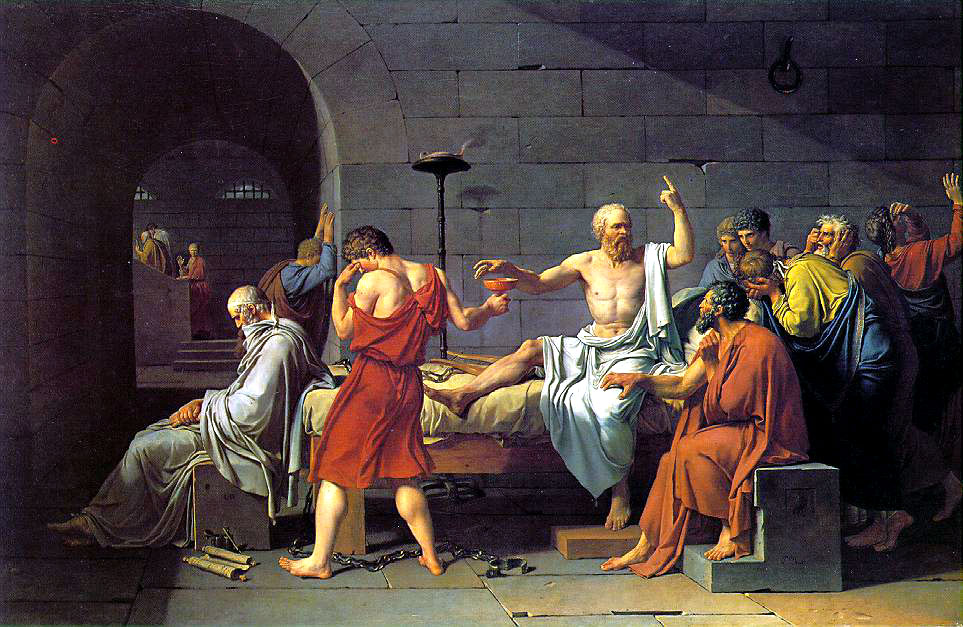
La muerte de Sócrates según David


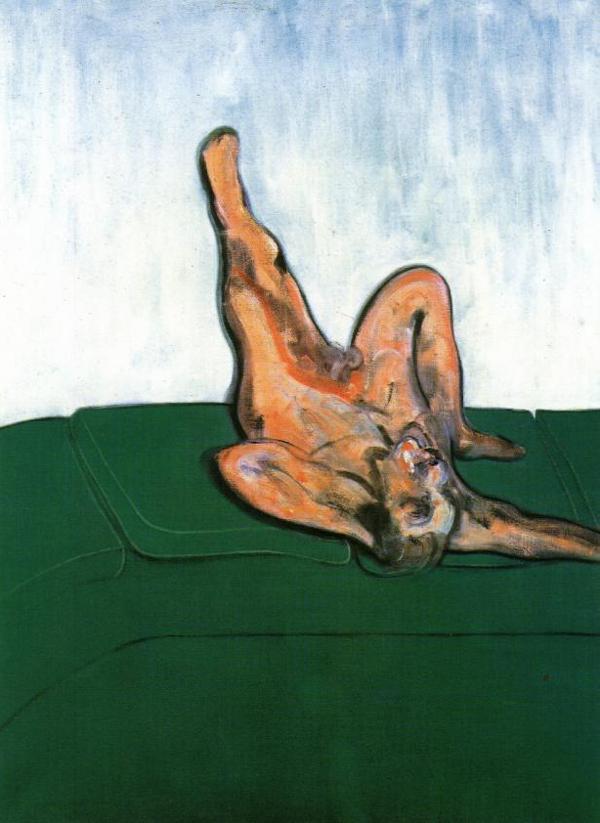
Deleuze según Bacon

Platón al contar la muerte de Sócrates crea un mito fundacional de la filosofía de Occidente: Sócrates habla su muerte, narra su propia experiencia de la muerte mientras la muerte ocurre. La muerte – entonces – deja de ser misterio para ser palabra. La muerte puede conocerse. El mito se instala con ferocidad en Occidente: con tanta violencia y seguridad lo hace que a pocos se les ocurre pensar en los efectos reales de la cicuta en el cuerpo. Sócrates tiene una muerte sabia, ordenada, dominada, entendida, domesticada: hablada. Deleuze – mucho más tarde y también dentro de la filosofía – tiene una muerte que no es palabra sino un grito: se lanza por una ventana: nada explica - nada deja escrito - nada dice: sólo se arroja por una ventana. La muerte de Deleuze reinstala el misterio de la muerte: lo innominado, lo que no puede conocerse: aquello que no puede ser explicado más que como misterio. Shakespeare – entonces – le puso palabras a todo - nombró todo – explicó todo – domesticó todo: ahí están sus obras que son para occidente tratados acerca de lo humano: respuestas al misterio. Shakespeare es Platón contando la muerte de Sócrates. El intento de este R&J es emular el gesto de Deleuze. Leer a Shakespeare desde el misterio y el silencio. Si a esto le sumo que mi conocimiento del alemán es limitado tendremos una experiencia más cercana al grito que a la palabra. Ofrecer una lectura de Shakespeare más cercana al misterio que a las certezas es el intento de este R&J. Por eso el suicidio es rector en esta producción y no el amor. El suicidio como grito. El suicidio como respuesta misteriosa al misterio del amor. Pero el suicidio aquí no es el de Platón, el suicidio aquí es el de Tsvietáieva, el de Plath, el de Celan, el de Deleuze: el suicidio como respuesta al misterio de la existencia y como entrada al misterio de la muerte. El suicidio como puente de misterios. El suicidio como un grito: pendulante, definitivo: un aullido como respuesta a la creación.

Alejandro Tantanian

Algo así como una explicación


Aislados por una catástrofe natural un grupo de personas se encierra en una cancha de básquet esperando que el horror se mitigue. Matan el tiempo: cuentan historias: una de las historias que se desgrana – a la manera de un moderno decamerón – es la de R&J – todos la conocen. Se entusiasman con la idea. La narran, la actúan: la viven, la biografían. Otra vez la orilla entre ficción (R&J en este caso) y la realidad (la cancha de básquet, realidad material del escenario, además). La historia se cuela en la realidad. El suicidio de los amantes despierta la voluntad oscura de llevar adelante este acto de manera individual y masiva: el peligro es enorme del otro lado de la cancha de básquet: la solución parece ser la muerte voluntaria: la historia de la muerte de los dos enamorados, el empedernido suicidio, la búsqueda de la salida de aquella realidad despierta en el grupo el deseo colectivo de la muerte. Pero la muerte por mano propia. El grupo – a medida que la historia de R&J avanza – va dictando su voluntad suicida. Así – entonces – R&J deviene la realidad material de aquella otra realidad material que parecía no contenerla: el espacio de presentación (la cancha) deviene espacio de representación (Verona o Mantua) y viceversa. La ficción construye la realidad o la realidad construye la ficción; o mejor aún: no existe borde entre ambas: sólo la voluntad de nombrar esto o aquello de manera tranquilizadora para no abismarse en los límites de lo impreciso.

Alejandro Tantanian

7.12.05

Paris's weapons / Las armas de Paris

3.12.05

Der Leiermann / El organillero


Der Leiermann
Wilhelm Müller / Franz Schubert

 
Drüben hinterm Dorfe steht ein Leiermann
Und mit starren Fingern dreht er, was er kann.
Barfuß auf dem Eise schwankt er hin und her
Und sein kleiner Teller bleibt ihm immer leer.

Keiner mag ihn hören, keiner sieht ihn an,
Und die Hunde brummen um den alten Mann.
Und er läßt es gehen alles, wie es will,
Dreht und seine Leier steht ihm nimmer still.

Wunderlicher Alter, soll ich mit dir geh'n?
Willst zu meinen Liedern deine Leier dreh'n?

...................................................

En las afueras del pueblo hay un organillero.
Y con dedos entumecidos le da a la cuerda penosamente.
Se tambalea desnudo sobre el hielo
Y su platillo siempre esta vacío.

Nadie quiere oírlo, nadie lo mira.
Y los perros gruñen alrededor del pobre viejo.
Y él lo ignora todo, no se inmuta.
Da cuerda a su organillo, nunca para.

Viejo extraño, ¿voy contigo?
¿Harás girar tu organillo para mis canciones?


Este lied fue propuesto por Jürgen Sarkiss, nuestro Teobaldo. /
This lied was proposed by Jürgen Sarkiss, our Tybalt.

30.11.05

Marina Tsvietaieva

Je suis belle / Yo soy bella


Romeo y Julieta según Anna Eger (nuestra Julieta) según Rodin.
Romeo and Juliet by Anna Eger (our Juliet) by Rodin.


29.11.05

Los niños de Bergman


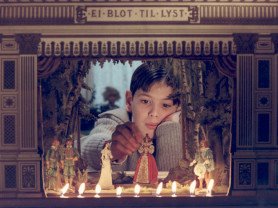
Hay en este R&J la mirada del niño - Tsvietáeva o Putte o Fanny o Alexander - un violín o una forma de mirar lo que se presenta ante los ojos. La crueldad - así - forma parte de cada uno de los que esperan encerrados en el espacio.

También es un lied de Schubert

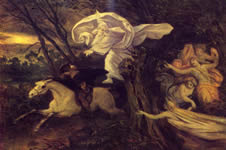
Johann Wolfgang von Goethe / Erlkönig


Wer reitet so spät durch Nacht und Wind?
Es ist der Vater mit seinem Kind;
Er hat den Knaben wohl in dem Arm,
Er faßt ihn sicher, er hält ihn warm.

»Mein Sohn, was birgst du so bang dein Gesicht?« -
»Siehst, Vater, du den Erlkönig nicht?
Den Erlenkönig mit Kron und Schweif?«
»Mein Sohn, es ist ein Nebelstreif.«

>Du liebes Kind, komm, geh mit mir!
Gar schöne Spiele spiel ich mit dir;
Manch bunte Blumen sind an dem Strand,
Meine Mutter hat manch gülden Gewand.<

»Mein Vater, mein Vater, und hörest du nicht,
Was Erlenkönig mir leise verspricht?«
»Sei ruhig, bleibe ruhig, mein Kind:
In dürren Blättern säuselt der Wind.«

>Willst, feiner Knabe, du mit mir gehn?
Meine Töchter sollen dich warten schön;
Meine Töchter führen den nächtlichen Reihn
Und wiegen und tanzen und singen dich ein.<

»Mein Vater, mein Vater, und siehst du nicht
dort Erlkönigs Töchter am düstern Ort?«
»Mein Sohn, mein Sohn, ich seh es genau:
Es scheinen die alten Weiden so grau.«

>Ich liebe dich, mich reizt deine schöne Gestalt;
Und bist du nicht willig, so brauch ich Gewalt.<
»Mein Vater, mein Vater, jetzt faßt er mich an!
Erlkönig hat mir ein Leids getan!«

Dem Vater grauset's, er reitet geschwind,
Er hält in Armen das ächzende Kind,
Erreicht den Hof mit Müh' und Not:
In seinen Armen das Kind war tot.
  
¿Quién cabalga tan tarde a través del viento y la noche?
Un padre con su hijo,
lo lleva seguro y caliente,
al resguardo de su regazo fiel.

- Hijo mío ¿por qué escondes tu asustado rostro?
- ¿Es el Rey de los Silfos, oh padre, tú no lo ves?
- ¿El Rey de los Silfos con su corona y manto?
¡Son alucinaciones hijo, que la niebla te hace ver!

¡Oh lindo niño, anda, ven conmigo!
Verás que juegos alegres te enseñaré.
¡Y qué flores tan extrañas florecen en mi orilla,
con las que mi madre hace dorados ramilletes!

- Padre mío, padre mío, ¿no oyes tú las promesas
con las que el rey de los Silfos pretende atraerme?
- No hagas caso, hijo mío es la fronda seca del árido
bosque, agitada por el viento.

- Lindo niño, ¿no quieres venir a mi palacio?
Te aguardan mis hermosas hijas en la entrada.
Cada una, en la noche, arrullará tu sueño.
y sabrán entretejer sus danzas y cantos,

- Padre mío, padre mío, ¿no ves allá en la sombra,
resplandecer las bellas hijas del monarca?
- Hijo mío, no hagas caso, es la difusa espesura,
lo veo bien y no hay nada más.

- Niño hermoso, amo tu belleza divina;
si no vienes por las buenas, emplearé la fuerza.
- Padre mío, padre mío, ¡mira cómo me aferra!
me lastiman sus manos. ¡Defiéndeme padre!

Atemorizado el padre clava las espuelas a su caballo,
aprieta contra su pecho al lloroso niño,
por fin llega al portal de su casona.
Mira, y en sus brazos el niño está muerto.

Un comienzo

Telón cerrado - - El niño entra lentamente. Su mirada es la que abre el telón - descubre la veladura – es el niño el que ve lo que sigue – el niño tiene los ojos en el dolor – el niño descubre el teatro – abre el telón: así - - El espacio se recibe vacío – se espera que el silencio hable el idioma del niño – el niño mira el espacio vacío – se entrega al silencio y pide por los seres que ama – el niño descubre la violencia de la soledad – parece querer llorar en el recinto abierto del teatro: el teatro es el espacio de la tristeza: el niño lo sabe – el niño lo escribe – el niño es ahora el habitante de la tristeza – pero también sabe que la tristeza puede ser la trama secreta de la noche: esta noche – la de Romeo y Julieta - - Nadie acude al llamado del niño – nadie escucha el ruego nocturno de los silenciosos – después – más tarde aparece ella: su compañera: su amiga de esta noche – se descubren – se acercan – se encuentran – se miran – se abrazan y ella le canta aquella canción que su madre supo derramar en sus oídos – la canción habla de un dolor lejano – de un espacio que ya no es el de esta noche – un lugar lejano y antiguo – perdido – la belleza de la voz es el camino hacia el descubrimiento del fuego que los une – el fuego que los trajo – el fuego es el poema – El espacio es verde como verde es el silencio que lo habita – nadie sabe la historia que se cuenta – nadie sabe que ahora son ellos los testigos del silencio – el cuento que hoy contamos es la presencia de las palabras en el silencio – es el fuego de la muerte que supo de un silencio más grande que el de Dios – Dios calla esta noche y el hijo lo busca con desesperación – el dolor del hijo es el abandono – el pequeño Romeo es hijo del hombre y sufre la ausencia del padre – son seres abandonados al silencio del Padre – en ellos el amor es el espacio para la re/ligión – se re/unen con el Padre en el desamparo y la desesperación – todo es luminoso: como el dolor – cuando la canción se refugia en el silencio los testigos del amor van entrando – se sientan en sus sillas luminosas – van ocupando el espacio que ahora deja de ser el desierto verde para ser esto que hoy tiene el nombre enmascarado de la verdad – son los testigos – los que ven – los invitados al drama – los actores del drama – los verdaderos protagonistas de la noche silenciosa – trazan la coreografía del alma: así – describen formas en el espacio desde las sillas quietas – ahora cantan en coro – sonante – gigante – verde y más – el prólogo que los une en la sentencia del amor de los amantes – los amantes de Verona entran al teatro y son los testigos los que cuentan el dolor – ellos son seres encerrados en el silencio de la muerte – esperan – ansiosos – el momento del filo entre las carnes – esperan la decisión final de los cuerpos: así – eclipse de esos cuerpos hoy en la pradera verde indefinida de aquellos niños perdidos en el bosque – son niños perdidos en un bosque – escapan de las garras del dolor – todos son hombres en espera de la única y maravillosa verdad: la muerte – el bosque es el espacio de la fuga – el espacio es verde – el espacio es un bosque – el espacio es el lugar de la espera – verde esperanza – se dice – ellos en el espacio silencioso del verde – el bosque de mentira es el lugar en el que esperan – ellos – son – sí – siempre les es dicho el mismo silencio – así – - y hoy lo cantan.

Alejandro Tantanian

27.11.05

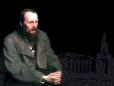
Fragmentos de Dostoevski

Demons

PART IV
CHAPTER 5: A WANDERER / PARAGRAPH 5

“There are seconds—they come five or six at a time—when you suddenly feel the presence of the eternal harmony perfectly attained. It's something not earthly—I don't mean in the sense that it's heavenly—but in that sense that man cannot endure it in his earthly aspect. He must be physically changed or die. This feeling is clear and unmistakable; it's as though you apprehend all nature and suddenly say, 'Yes, that's right.' God, when He created the world, said at the end of each day of creation, 'Yes, it's right, it's good.' It ... it's not being deeply moved, but simply joy. You don't forgive anything because there is no more need of forgiveness. It's not that you love—oh, there's something in it higher than love—what's most awful is that it's terribly clear and such joy. If it lasted more than five seconds, the soul could not endure it and must perish. In those five seconds I live through a lifetime, and I'd give my whole life for them, because they are worth it. To endure ten seconds one must be physically changed."


PART IV
CHAPTER 6: A BUSY NIGHT / PARAGRAPH 2

“I am bound to shoot myself because the highest point of my self-will is to kill myself with my own hands.”
“But you won't be the only one to kill yourself; there are lots of suicides.”
“With good cause. But to do it without any cause at all, simply for self-will, I am the only one.”
“He won't shoot himself,” flashed across Pyotr Stepanovitch's ruined again.
“Do you know,” he observed irritably, “if I were in your place I should kill some one else to show my self-will, not myself. You might be of use. I'll tell you whom, if you are not afraid. Then you needn't shoot yourself to-day, perhaps. We may come to terms.”
“To kill some one would be the lowest point of self-will, and you show your whole soul in that. I am not you: I want the highest point and I'll kill myself.”
“He's come to it of himself,” Pyotr Stepanovitch muttered malignantly.
“I am bound to show my unbelief,” said Kirillov, walking about the room. “I have no higher idea than disbelief in God. I have all the history of mankind on my side. Man has done nothing but invent God so as to go on living, and not kill himself; that's the whole of universal history up till now. I am the first one in the whole history of mankind who would not invent God. Let them know it once for all.”
“He won't shoot himself,” Pyotr Stepanovitch thought anxiously.
“Let whom know it?” he said, egging him on. “It's only you and me here; you mean Liputin?”
“Let every one know; all will know. There is nothing secret that will not be made known. He said so.”
And he pointed with feverish enthusiasm to the image of the Saviour, before which a lamp was burning. Pyotr Stepanovitch lost his temper completely.
“So you still believe in Him, and you've lighted the lamp; 'to be on the safe side,' I suppose?”
The other did not speak.
“Do you know, to my thinking, you believe perhaps more thoroughly than any priest.”
“Believe in whom? In Him? Listen.” Kirillov stood still, gazing before him with fixed and ecstatic look. “Listen to a great idea: there was a day on earth, and in the midst of the earth there stood three crosses. One on the Cross had such faith that he said to another, 'To-day thou shalt be with me in Paradise.' The day ended; both died and passed away and found neither Paradise nor resurrection. His words did not come true. Listen: that Man was the loftiest of all on earth, He was that which gave meaning to life. The whole planet, with everything on it, is mere madness without that Man. There has never been any like Him before or since, never, up to a miracle. For that is the miracle, that there never was or never will be another like Him. And if that is so, if the laws of nature did not spare even Him, have not spared even their miracle and made even Him live in a lie and die for a lie, then all the planet is a lie and rests on a lie and on mockery. So then, the very laws of the planet are a lie and the vaudeville of devils. What is there to live for? Answer, if you are a man.”
“That's a different matter. It seems to me you've mixed up two different causes, and that's a very unsafe thing to do. But excuse me, if you are God I If the lie were ended and if you realised that all the falsity comes from the belief in that former God?”
“So at last you understand!” cried Kirillov rapturously. “So it can be understood if even a fellow like you understands. Do you understand now that the salvation for all consists in proving this idea to every one I Who will prove it? I! I can't understand how an atheist could know that there is no God and not kill himself on the spot. To recognise that there is no God and not to recognise at the same instant that one is God oneself is an absurdity, else one would certainly kill oneself. If you recognise it you are sovereign, and then you won't kill yourself but will live in the greatest glory. But one, the first, must kill himself, for else who will begin and prove it? So I must certainly kill myself, to begin and prove it. Now I am only a god against my will and I am unhappy, because I am bound to assert my will. All are unhappy because all are afraid to express their will. Man has hitherto been so unhappy and so poor because he has been afraid to assert his will in the highest point and has shown his self-will only in little things, like a schoolboy. I am awfully unhappy, for I'm awfully afraid. Terror is the curse of man. . . . But I will assert my will, I am bound to believe that I don't believe. I will begin and will make an end of it and open the door, and will save. That's the only thing that will save mankind and will re-create the next generation physically; for with his present physical nature man can't get on without his former God, I believe. For three years I've been seeking for the attribute of my godhead and I've found it; the attribute of my godhead is self-will! That's all I can do to prove in the highest point my independence and my new terrible freedom. For it is very terrible. I am killing myself to prove my independence and my new terrible freedom.”
25.11.05

En Clarín, hoy


TEATRO: ENTREVISTA CON ALEJANDRO TANTANIAN

Infiel a Shakespeare

El director y dramaturgo viajó a Suiza, para montar "Romeo y Julieta" con asistentes argentinos.


Susana Villalba. ESPECIAL PARA CLARIN

El director, dramaturgo y actor Alejandro Tantanian acaba de viajar a Suiza para dirigir Romeo y Julieta invitado por el Teatro de Lucerna. Este teatro, ubicado en el cantón alemán y dedicado a ópera, danza y teatro de texto, cuenta con subsidio estatal y un elenco de actores estables. El director del área teatro, Peter Carp, ya conocía a Tantanian y su obra por haber coincidido con él en las Becas de la Academia de Stuttgart, o sea que no espera precisamente una versión fiel de la obra de Shakespeare. Por el contrario, la libertad con que Tantanian podrá decidir se refleja en incluso en el equipo que suele acompañarlo: Oria Puppo en vestuario, Edgardo Rudnitzky en diseño sonoro y Jorge Macchi en escenografía. "Macchi había visto una foto de refugiados del Katrina en una cancha de básquet y de allí tomó el diseño espacial", contó el director antes de partir.

¿Cómo relacionó una cancha de básquet con "Romeo y Julieta"?

Es una de las obras más difundidas de Shakespeare así es que trabajo con el supuesto de que el público ya la conoce y la tomo como material para otro desarrollo. Puse el acento en que voy a contar con un elenco alemán con el que no nos conocemos y no compartimos el idioma. Así es que pensé partir de lo que Romeo y Julieta significa para cada actor, lo que significó en su vida y en su carrera, cómo se acercó cada uno a ella por primera vez. De ahí derivó la idea de la situación inicial: los actores están en un sitio del que no pueden salir porque algo afuera es amenazante, por eso la idea de refugio, y comienzan a contar historias, un poco como en el Decamerón. Así se irá armando Romeo y Julieta, como el relato que se impone en esa noche hasta que en el final no se sabe si los que mueren son los personajes o esos actores que cuentan sobre los personajes. En esto tiene algo de similitud con Los mansos, que se fue desarrollando paralelamente a que iba pensando la otra.

Tantanian se refiere a la obra que deja montada en El camarín de las musas y que está basada en El idiota de Dostoievski. En ella superpone anécdotas biográficas y de las biografías de los actores con momentos de los personajes memorables del escritor ruso. "En Los mansos aparece la idea de Dostoievski de que sólo en la caída el hombre puede ser como Cristo. Y en lo que voy a encarar ahora en Suiza me detuve en que en Romeo y Julieta, si leemos la obra sin creer que ya sabemos de qué se trata, encontramos que también aparece una pulsión muy fuerte hacia el suicidio. Me interesó pensarla como si cada uno de los amantes deseara al otro porque intuye a la persona con la que irá a la muerte. Trabajé entonces con las cartas de los poetas que se suicidaron, desde Pizarnik a John Donne, de von Kleist a Silvia Plath, basándome en el libro El dios salvaje, de Al Alvarez. También me basé en la ensayista argentina Nelly Schnaith, que analiza en el relato de Platón cómo Sócrates mientras va muriendo va poniéndole palabras a la muerte, y eso lo confronta con la muerte de Deleuze que, en cambio, es como un grito.

En suma, Tantanian intenta revisar los mitos a través de los cuales pensamos la muerte y el amor con un discurso predeterminado, y confrontarlo con el suicidio como voluntad, en el sentido de que lo trágico no es un destino que nos acontece inevitablemente. Romeo und Julia, como se escribe allí, se estrenará en Lucerna el 13 de enero y pasará a formar parte del repertorio durante seis meses.

En sus últimos trabajos, este director intenta generar o recrear en el espectador la emoción de cuando uno se acerca por primera vez a un texto, así trabajará su Romeo y Julieta y así ocurre en Los mansos, en la que es frecuente, dice, ver salir a los espectadores con lágrimas en los ojos. Sin embargo, aunque sus primeras obras no eran tan emotivas, ya aparecía en ellas una idea que por lo visto continúa: va apareciendo en fragmentos una obra que se está escribiendo en escena desde tantos puntos de vista como actores hay en el escenario. Esto puede rastrearse fácilmente ahora que acaban de aparcer dos libros de Tantanian autor. Uno inaugura la nueva colección Teatro de Editorial Colihue y reúne cinco de sus primeras obras. Otro, en las ediciones del Centro Cultural Ricardo Rojas, incluye dos obras y dos óperas, encabezadas por la que da nombre al libro: Muñequita o juremos con gloria morir.

Un año pleno para un director que además realizó la puesta en escena de algunas óperas contemporáneas en el CETC, repuso su espectáculo musical de lágrimas, con el que estuvo también en Europa, y continuó con su tarea de docente en la Escuela de Arte Dramático de la Ciudad de Buenos Aires.

21.11.05

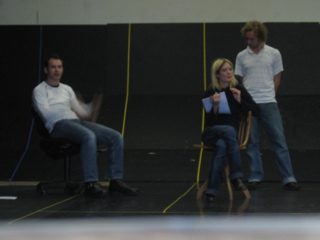
Algunas fotos del ensayo de hoy


7.11.05

Algunos suicidados literarios

Cesare Pavese


Guy de Maupassant


Ryunosuke Akutagawa


Virginia Woolf


Sobre un librero que recomienda...


Sobre Jean Amery


I
II
III

Jean Améry, conciencia desgraciada.

No me angustia ni el ser ni la nada ni dios ni la ausencia de dios,
sólo la sociedad: pues ella, y sólo ella, me ha infligido el desequilibrio
existencial al que intento oponer un porte erguido. Ella y sólo ella
me ha robado la confianza en el mundo. La angustia metafísica
es una preocupación elegante de alto estanding.

Jean Améry es indigesto, irreconciliable... "el anhelo individual de reversibilidad de los procesos irreversibles". Es el grano, la yaga, la herida que ha tomado voz propia frente al cuerpo y se resiste a ser una parte más entre las partes. Es la eterna hemorroides de la Historia tomando conciencia de sí, la herida identificándose a sí misma y exigiendo su reconocimiento. Figura del desarraigo por excelencia y mancillado por "la lógica de las SS", la revuelta y el rencor contra el olvido han tejido la vida y la obra de Jean Améry hasta ahogarse entre barbitúricos en la primavera de 1978, finalmente vencido por la resignación y el olvido. Pero el pesimismo de Améry no es sentimentalista ni da concesiones literarias al dramatismo; aborrece los efectismos, los rodeos y los lagrimones... porque él es real. Detesta los artificios demostrativos y, sin embargo, con él, al hilo de la cruda fenomenología de su sangre, se tejen y se despachan los argumentos de Platón, Nietzsche o Carnap; la lucidez de los ociosos seminarios de toda Europa es puesta patas arriba, en ridículo y amenazada (como lo fue el propio Améry intelectual en el campo ) por la lucidez de una brutal realidad hecha carne.

La obra de Améry es un hervidero de rencor contra la realidad triunfante y olvidadiza, un fino hervidero que todo lo teje bajo la lucidez del absolutamente aplastado. Los pesimismos y optimismos de seminario no dejan de ser actitudes estéticas más o menos respetables frente al horror y la violencia (y no "la nada") de una única realidad: la realidad social. La Nada es el lujo de los no aplastados; más aún, es la moneda con la que trafican los que aplastan, los que reniegan de su condición de prójimos. Frente al horror de esa realidad, Améry no pide mera venganza ni odio, tan sólo la conciencia del duelo. Ése sería, según él, el cometido objetivo de sus resentimientos, la única cura posible a su herida: el recuerdo, acaso, de la realidad sellada en su semblante. Su propio retrato es un desafío a las alegres y superficiales reconciliaciones, a cualquier baratija filosófica de quinto grado. Su rostro pide su integración en nuestra alegría, no su traición ni su olvido: la inconsciente alegría es cómplice de la realidad que lo marcó, la ingenua inocencia es, acaso, el preludio del crimen. Su rostro mismo es una "prueba de fuego" para cualquier estómago y su obra, una verdadera batidora de metafísica.

Su pensamiento no ha brotado de ninguna ilusión; se ha tejido a partir de la sola brutalidad y desarraigo de su experiencia biográfica. Su "novela ensayístico-autobiográfica" (junto a Revuelta y resignación, Años de peregrinaje nada magistrales y Levantar la mano sobre uno mismo) está completamente alejada de cualquier filosofía de campus. Y no, desde luego, porque él no haya sido asimismo carne de campus, sino porque su obra ha cuajado (literalmente) a la intemperie, como filosofía de campo, como un auténtico humus filosófico; sus ideas no se han catalizado en ninguna especie de "taller", la tradición filosófica no ha quedado recogida en él desde ningún maximum racional, desde ningún supuesto de criba ideológica autoconsciente, sino desde la herida a carne viva. Es una obra tejida en los límites mismos de la razón y el lenguaje, pues su semilla germina en un terreno que "neutraliza" objetivamente cualquier referente social: "la lógica de las SS" en el campo de concentración, donde la trascendencia y la espiritualidad son "absolutamente irreales" o "lujos prohibidos", donde queda anulado cualquier tipo de consuelo a través de reminiscencias estéticas... su obra no brota ante ni tras el primer golpe recibido en comisaría, sino más allá de él, en la absoluta desconfianza y extrañamiento del mundo: su "autoconciencia crítica" no es sino la conciencia de una epidermis mancillada, de cada uno de los límites materiales y corpóreos del sentido social (placer, lengua, patria...). Jean Améry (pseudónimo de Hans Mayer) es conciencia desgraciada consumada, es conciencia errante y desarraigada más allá de la identidad cultural judía.
Más allá de la culpa y la expiación no es "un documento más" sobre Auschwitz; la fenomenología de esa conciencia individual que fue Jean Améry de su experiencia del campo, pese a la particularidad histórica del nacionalsocialismo y de la propia existencia de Hans Mayer, trasciende cualquier tipo de particularidad histórica o personal. Quienes se acerquen a esta obra al modo de aquellos que (como Adorno, Blanchot o Levinas) creen estar ante la expresión de algo "distinto", absolutamente extraño y ajeno, y quedan embebidos por el problema de "seguir pensando después de Auschwitz", probablemente traicionen el propio cometido de Améry: la conciencia de que el horror y la violencia se esconde tras "los rostros comunes". Sin duda, la conciencia de Améry es una conciencia límite, pero no ya sólo de Auschwitz, sino de los límites materiales y corpóreos ( trascendentales a la Historia) del sentido social, de la socialización; y límites, por cierto, que no eran abstracto-negativos respecto a las realidades sociales históricas, sino presentes (efectivos) y, por tanto, conjugados (aun en diversos grados, desde luego) con los propios procesos socializadores: los límites mismos que alcanzaron su máxima expresión en la "experiencia nazi"... pero también en la persona Hans Mayer a la que, por ejemplo, su madre le dijo que no sería nadie en la vida.

Pero por ello también la conciencia de Améry es la expresión más pura o más prístina de lo que pudiera entenderse por "conciencia socialista" en las tradiciones anarco-marxistas y, por ende, mucho más profunda que el romo sentido en el que se ha devaluado como "conciencia proletaria": "La conciencia de mi ser judío, formada en la catástrofe, no es ideología. Es comparable a la conciencia de clase que Marx pretendió desenmascarar para el proletariado del siglo XIX". La "conciencia socialista" trasciende por completo la condición económica, sin negarla: es trascendental a ellas: se diría que la conciencia judía, si por tal entendemos una conciencia que trascienda la propia tradición cultural y sus alusiones teológicas (por tanto, una conciencia judía secularizada) es el fundamento irrenunciable de cualquier conciencia socialista, la verdadera conciencia de clase: la de los desheredados y desarraigados, la de los extrañados del mundo, la de los aplastados en su impotencia ante la segregación y la injusticia:

Ser judío significaba, por un lado, aceptar como universal la sentencia de muerte dictada por el mundo, frente a la cual fugarse hacia la interioridad habría sido sólo ignominia pero, por otro lado, también cabía oponer rebelión física...

... "ser judío" significaba sentir en el fuero interno la gravedad de la tragedia pasada [...] no significa sólo soportar en mi interior una catástrofe acontecida ayer y que no cabe excluir en el futuro, sino que, además de un deber, entraña miedo...

La solidaridad respecto a la amenaza es todo cuanto me vincula a mis contemporáneos judíos, tanto creyentes como agnósticos, tanto de tendencias sionistas como asimilacionistas. Para ellos esto es poco o casi nada. Para mi persona y mi estabilidad, empero, significa mucho [...]. Sin el sentimiento de afinidad con los amenazados sería un exiliado de la realidad que renuncia a sí mismo...

Quien se acerque a la obra de Améry se encontrará con un "ser judío" brotado de la propia brutalidad y el extrañamiento social, un "ser judío" noble y sin artificios (sin lujos, pues); se encontrará, me parece, con una pulcra fenomenología del núcleo de lo que Marx pudo entender por "conciencia de clase proletaria", conciencia devenida en autodestrucción por la imposibilidad de "exteriorizarse y actualizarse". "La herida Améry" (para utilizar la expresión de Enrique Ocaña, emulando a Adorno) no se tiene más que a sí misma. No tiene más identidad que el desarraigo mismo. Ése fue su único soporte personal, su único asidero de realidad. No hay reconocimiento más allá de ella. Ésa es, probablemente, la desgracia más profunda del herido, la de que no puede reconocerse ni ser reconocido más que entre los heridos; no hay puente que salve la distancia con "los otros" ni palabra de consuelo al dolor del desarraigo más que el propio duelo... pero el duelo ya supone estar herido y no hay conciencia de duelo más allá de la herida. La "extrema soledad" que pide que los torturadores "se nieguen a sí mismos" para que recuperen su condición de prójimos con las víctimas sólo obtiene silencio y culpa por respuesta: "la culpa colectiva pesa sobre , no sobre ellos. El mundo, que perdona y olvida, me ha condenado a mí, no a aquellos que asesinaron o consintieron el asesinato. Yo y la gente como yo somos los Shylocks, no sólo moralmente condenables a los ojos de los pueblos, sino también estafados en nuestra libra de carne. El tiempo ha consumado su obra. En silencio".

"Sólo perdona realmente quien consiente que su individualidad se disuelva en la sociedad"; "...todo perdón y olvido forzados mediante presión social son inmorales". "Se me ha infligido una herida. Necesito desinfectarla y vendarla, no reflexionar sobre por qué el verdugo me asestó el golpe, y de esa guisa, al comprender sus motivos, acabar medio disculpándolo". La "condición de prójimo" es, acaso incluso pese a Améry, una ilusión. No hay oídos al otro lado de la franja. No hay respuesta. La incomunicabilidad forzada de la herida hace que se pudra en la soledad más absoluta, más allá de la culpa y la expiación. Pero el anhelo de socialización o bienestar jamás podrá levantarse sobrevolando sus propias heridas, las producidas por el propio proceso socializador. Entonces el anhelo se convierte en nada, en angustia, en traición. Se hace cómplice entonces del "pecado original", pues la nada no es, en efecto, sino una de las maneras en que se dice el ser, es decir, la destrucción...

sobre Más allá de la culpa y la expiación de Jean Amery por Miguel Á. Vázquez Villagrasa.

Jean Améry: A Biographical Introduction


by D. G. Myers

Originally published in Holocaust Literature: An Encyclopedia of Writers and Their Work, ed. S. Lillian Kremer (New York: Routledge, 2002). © 2002. All rights reserved.

Jean Améry (1912-1978) was a Jewish victim of the Nazis whose entire career was devoted to exploring and resisting the notions of Jew and victim. Although he rejected the advances of those who wished him to become a professional


Jean Améry

survivor, he equally scorned those who might deny that his Auschwitz number was "a basic formula of Jewish existence" or that the Holocaust is "the existential reference point for all Jews." An autobiographical and philosophical essayist whose texts are notoriously intransigent—hard to categorize, even harder to cherish—Améry wrote only one slim volume on the Holocaust. At the Mind’s Limits is one of the central texts, however, on Jewish victimhood.

Améry was born Hans Maier in Vienna on October 31, 1912. As a boy he made his home in his parents’ native Hohenems, a small resort city in the state of Vorarlberg, in the alpine provinces of western Austria. The family had been settled there since the seventeenth century. His great-grandfather, a Vorarlberg innkeeper and butcher, "spoke fluent Hebrew," according to his great-grandson. By the time of Améry’s birth, however, the Hebrew fluency had disappeared; the family was estranged from its Jewish origins, assimilated and intermarried. Améry’s father was more Austrian than Jewish. "The picture of him did not show me a bearded sage," Améry said, "but rather a Tyrolean Imperial Rifleman in the First World War." The father died in battle, in 1916, when his son was too young to remember him. Améry’s mother, who supported her only child and herself by keeping an inn, was Roman Catholic. "Several times a day she invoked Jesus, Mary, and Joseph," he says, "which sounded in our native dialect like ‘Jessamarandjosef.’"

Améry was educated in philosophy and literature in Vienna. He was studying there when the Nazis came to power in Germany in 1933. At once he immersed himself in the canonical writings of antisemitism and National Socialism; thus began, he said, "an entirely impossible éducation sentimentale for a young Jew. . . ." Coupled with the political situation in Austria, this reading deeply complicated Améry’s thinking about being Jewish. "I wanted by all means to be an anti-Nazi, that most certainly," he explains, "but of my own accord; I was not yet ready to take Jewish destiny upon myself. . . . I really found myself in a confusing state of mind: I was an Austrian who had been raised as a Christian, and yet I was not one." For the first time Améry began to understand himself as an outsider to the culture in which he lived. The decisive event was the promulgation, in 1935, of the Nuremberg Laws. Améry soon came to know the text of the laws by heart. "The overwhelming majority not only of the German people but also of my own Austrian people," he realized, "had excluded me from their community." But it did not follow that there was a place for him in the organized Jewish community. Orthodox Judaism was "another, thoroughly alien world." It was Christianity that drew him, because to be a Christian "means participation in our culture" (his emphasis). Judaism left Améry bored; "the synagogue was the Other." Over time, however, he became increasingly convinced that his intellect and "spiritual constitution" were Jewish—"not in the sense of upbringing or milieu," he says, "which in my case were as un-Jewish as possible, but by birth." This essentialist conviction, which he did not flinch at being described as racist, influenced his self-understanding for the rest of his life.

After the Anschluss in March 1938, Améry fled first to France and then, upon its defeat by the Germans in May 1941, to Belgium. There he joined the Resistance, although he later acknowledged that this was merely the last unconscious attempt to evade his Jewish identity. "The Jews were hunted, cornered, arrested, deported because they were Jews," he writes, underlining every word, "and only because of that. Looking back, it appears to me that I didn’t want to be detained by the enemy as a Jew but rather as a resistance member." And so in due course—in July 1943—he was arrested by the Gestapo for spreading anti-Nazi propaganda among the German occupation forces in Belgium. Améry believed he knew what was in store for him. He was widely read in the already substantial literature of the concentration camps. Whatever happened to him, he believed, would have merely to be "incorporated into the relevant literature, as it were." But nothing could prepare him for the experience of torture. Imprisoned in Fort Breendonk, Améry was interrogated by the SS for several days. His hands


Jean Améry

were shackled behind him, and he was suspended by his wrists from a hook in the ceiling ("there was a crackling and splintering in my shoulders that my body has not forgotten until this hour. . . . I fell into a void and now hung by my dislocated arms, which had been torn high from behind and were now twisted over my head"). Then he was beaten with a horsewhip. Although he told the Gestapo nothing useful, it was not because of heroic opposition. He confessed everything; he even invented political crimes; but he knew only the aliases of his comrades in the Resistance and had no real information to divulge. Once they realized he was useless to them—once they realized he was a Jew and not just a political prisoner—the Gestapo shipped him off to Auschwitz.

Améry endured a year in Auschwitz III, the Buna-Monowitz labor camp. Lacking a manual skill, he was assigned to a labor detail at the I-G Farben site, digging dirt, laying cables, lugging sacks of cement and iron crossbeams. He survived—somehow. Unlike his fellow Auschwitz inmate Viktor E. Frankl, Améry refused to derive theory from his survival. Many years later he agreed that the "religiously or politically committed" (Orthodox Jews, orthodox Marxists) had a better chance of surviving, or at least of dying with more dignity. They were able to look beyond the basic reality of Auschwitz. For them the horrors were weakened by being reinterpreted as a renewal of creation when evil was released into the world or as natural political martyrdom. They had, in other words, a mode of transcendence that was anchored to a reality that the Nazis could not reach, because it existed in faith. "[W]hoever is, in the broadest sense, a believing person, whether his belief be metaphysical or bound to concrete reality, transcends himself," Améry says. "He is not the captive of his individuality; rather he is part of a spiritual continuity that is interrupted nowhere, not even in Auschwitz." But Améry was an unbeliever from first to last. He had nothing but himself to fall back upon. He was an intellectual, but confronted by a reality that could not be interpreted as anything other than horror, he found that intellect had lost its fundamental quality of transcendence. There was no other reality to which a mere intellectual could appeal. The claim of Auschwitz was total.

Améry was evacuated first to Buchenwald and then to Bergen-Belsen ahead of the advancing Red Army, and it was at Belsen that he was liberated in April 1945. Returning to Brussels, he passed the rest of his life outside the cultural mainstream. When he began to write for the German-language press of Alemannic Switzerland, he chose a "French-sounding pen name," a translation of Hans into French and an anagram for a common variant of his surname. The pseudonym signified his rejection of German culture, his identification with French; yet Améry continued to write in German. Even so, he refused to travel to Germany for two decades after the war. Only in 1964, at the urging of the German poet Helmut Heissenbüttel, who worked for the South German Broadcasting Corporation, did Améry finally break his silence in Germany, delivering a radio address on the intellectual in Auschwitz. It became the opening essay in Jenseits von Schuld und Sühne ("Beyond Guilt and Atonement"), his first and only Auschwitz book, which followed in 1966. Translated by Sidney and Stella P. Rosenfeld as At the Mind’s Limits, the book was published in English in 1980.

By then Améry had published five collections of journalism: Karrieren und Köpfe ("Careers and Heads: Portraits of Famous Contemporaries," 1955), Teenager-Stars ("Teenager Stars: The Idols of Our Time," 1960), Im Banne des Jazz ("Under the Spell of Jazz," 1961), Geburt der Gegenwart (also 1961, translated as Preface to the Future: Culture in a Consumer Society), and a study of Gerhart Hauptmann, "the eternal German" (1963). He estimated that he had published some 15,000 pages before he undertook At the Mind’s Limits. Only then did his literary career—his "entry into German literature," as he preferred to say—really begin. The Auschwitz book changed everything. He was fifty-four. At last he had found the literary identity he had been seeking since adolescence. If the book did not make him very much money, at least it made him famous. Suddenly he was in demand; he was invited to contribute essays, to deliver radio talks, to join conferences and symposia. "I have the suspicion," he said later, "that I merely struck a chord that began to vibrate just at a time when it was still fashionable to occupy oneself with the fate of the Nazi victims, and that [by the late seventies], when my friends on the Left are representing Israel as a universal plague and everyone’s sympathies are focused on the Palestinian resistance fighters, I couldn’t tempt a soul with this book."

At the Mind’s Limits released him from "the drudgery of writing articles." Améry could afford at last to take his time and to worry a subject—to write the things that were weighing upon him. The public, however, wanted to hear nothing else from him except more about victimhood. Améry was resistant. His newfound status was a "market phenomenon, hostile to the intellect"; and as such, it was a threat to him. He never again wrote at any length about Auschwitz. His next book, Über das Altern, was published three years later—in 1969. (On Aging was translated into English in 1994 by John D. Barlow.) Two years after that came Unmeisterliche Wanderjahre ("Lean Journeyman Years").


Améry’s grave in Vienna
Photo by Frantisek Zobray

This chronological account of Améry’s intellectual development left a gaping hole at its center. It said nothing whatever about the years of the Holocaust. (It remains untranslated into English.) Améry describes these "slim volumes" as an "autobiographical trilogy." But they are not autobiography in any conventional sense. They omit "everything private and anecdotal." Améry does not tell stories about himself, but accepts his own pressing concerns as occasions for reflection and—to permit him his own emphasis—he "subjectively explore[s]" rather than objectively records his experience. He starts from the concrete event, but does not become lost in it. His later books are, in the words he used to describe At the Mind’s Limits, "personal confession refracted through meditation." He found his literary voice at last, in his fifties, and his "personal and intellectual life . . . became a contemplative essay." Two novels followed: Lefeu oder der Abbruch ("Lefeu, or the Demolition," 1974) and Charles Bovary, Landarzt ("Charles Bovary, Country Doctor," 1978). His philosophical inquiry on suicide, Hand an sich Legen, was published in 1976. Two years later—on October 17, 1978—Améry took his own life in Salzburg, and was buried in the Zentralfriedhof in Vienna. His Auschwitz number was engraved on the tombstone.

At the Mind’s Limits is neither a systematic nor a chronological treatment of Améry’s experience in the Holocaust. The hundred-page book consists of five essays, arranged in the order of their composition. They are held together not by careful organization but by a common theme, which Améry describes as "the subjective state of the victim." The title essay explores the fate of the mind in Auschwitz. "Torture" reaches back to narrate what Améry had undergone at Fort Breendonk. "How Much Home Does a Person Need?" takes a further step back to detail the psychic experience of the refugee. "Resentments" moves forward to take up the interior life of the victim after the Holocaust. "On the Necessity and Impossibility of Being a Jew" offers Améry’s conclusions on Jewish identity after a lifetime of being forced to confront the question.

Améry’s principal contribution to understanding the Holocaust is his concept of losing trust in the world. Perhaps better than any other Holocaust writer, Améry shows that the liberal pillars upon which Western civilization rests are not dug very deep; they are merely taken for granted. Political freedom and human dignity are measured by what is "possible and humanly acceptable"; they are temporary and hastily constructed social arrangements which disappear at the first blow aimed at a prisoner. "[W]e can live," Améry says, "only if we grant our fellow man life, ease his suffering, bridle the desire of our ego to expand." In the material security of our daily lives, we are unaware just how much we trust others to grant us life, and if not to ease our suffering at least not to cause it. But the victim of torture, the survivor of Auschwitz, has lost that trust forever. "Whoever was tortured, stays tortured," Améry concludes. He is indelibly burned with the knowledge that trust in the world—the trust that no one will lay hands on you—is astonishingly fragile, and can be lost at any moment. He knows something that they do not teach you in schools: that the Other can be absolute, and can exercise this absolute power by inflicting suffering.

For Améry, then, the Holocaust is central to human self-understanding because it represents not an accidental function of the Nazi regime, but its essence. Améry would have liked to "introduce certain Auschwitz books into the upper classes of secondary school as compulsory reading," because these books would introduce students to an idea that is indispensable to any humanistic curriculum in a post-Holocaust era—the idea of the victim, the "dead man on leave." If dignity is the right to live granted by society, then the Third Reich demonstrates how easily the grant can be revoked. Améry is not particularly interested in the perpetrators of the Holocaust. "The crimes of National Socialism had no moral quality for the doer," Améry explains. "The monster, who is not chained by his conscience to his deed, sees it from his viewpoint only as an objectification of his will, not as a moral event." Améry’s literary ambition in At the Mind’s Limits is to speak from the viewpoint of the victim, for whom the National Socialism had a moral quality. He seeks to understand suffering from the inside rather than extorting pity and special consideration for victims.

Améry thus stands as a challenge to the increasingly common view, of which the historian Peter Novick is merely one representative, that the Holocaust encourages contemporary Jews to adopt a "victim identity based on the Holocaust," a "fashionable victimhood" which is exploitative


"The Jew Etc."
by R. B. Kitaj
(1976—unfinished)
Oil and charcoal on canvas, 60 x 48

and phony (see The Holocaust in American Life, pp. 190-202). While Améry certainly agrees that the existence of the Jews has been forever determined by the Holocaust, At the Mind’s Limits does not celebrate victimization. Instead, the book engages in a fundamental redefinition of victimhood. To be a victim is no longer to be the object of other people’s designs. In the sort of post-Holocaust thinking practiced by Améry, the Jewish victim makes himself the subject of his own history.

"Whoever attempts to be a Jew in my way and under the conditions imposed upon me," Améry says, "whoever hopes, by clarifying his own Holocaust-determined existence, to draw together and shape within himself the reality of the so-called Jewish Question, is wholly void of naiveté." Wholly void of naiveté because such a Jew is no longer lulled by "[d]eclarations of human rights, democratic constitutions, the free world and the free press." He no longer dwells in the illusion that human identity is something optional, like a Christmas gift that can be exchanged. He has learned that his identity—his personhood—is a necessity. "I . . . am precisely what I am not," Améry says, "because I did not exist until I became it, above all else: a Jew." "I became a person," Améry explains, "not by subjectively appealing to my abstract humanity but by discovering myself within the given social reality as a rebelling Jew and by realizing myself as one." Note the emphasis on rebelling. He is a Jew who grasps but also rebels against the social declaration that to be a Jew is to be sentenced to death. Another name for this sentence was Auschwitz. Thus Améry’s "phenomenological description of the existence of the victim," as he calls it in the preface to the first edition, is the exact opposite of the exploitation of victimhood. If the Jews now see their existence as having been determined by the Holocaust it is not that they have not adopted a "fashionable victimhood," but rather that they have become the necessary subject of their own drama. "Without the feeling of belonging to the threatened," Améry says, "I would be a self-surrendering fugitive from reality."

Although not halakhically a Jew, Améry insists nevertheless that being Jewish is a necessity for him. But it is also an impossibility, precisely because he is not halakhically Jewish; not, that is, a Jew as a member of a community. "With Jews as Jews I share practically nothing," he writes: "no language, no cultural tradition, no childhood memories." Perhaps then a "catastrophe Jew" rather than a halakhic Jew, or a "non-non-Jew": lacking faith in the God of Israel, lacking Yiddish or Hebrew, lacking the Jewish tradition, he is a Jew because he learned under the Nazis that he is not permitted to be anything else. To be a Jew and a victim—to be a Jewish victim—is to live without "positive determinants." But unlike most men and women, Améry was willing to live this way, because he was willing to see his thought through to the end.

According to Améry, the Holocaust assumed importance only later—a generation after the liberation of the camps—because the Jewish victims of the Nazis "were forced to relinquish" any sense of victory in the defeat of Germany. The rehabilitation of the nation that had been the Third Reich outstripped the rehabilitation of its victims. By the sixties, when he began at last to speak publicly on the camps, the world reaction to Germany and Israel made the discrepancy even more evident to Améry. While Germany had been rejoined to Europe, normalized and eventually to be reunited, Israel remained a pariah nation. The Holocaust was a wound that had not been healed. Améry occupied an "uncomfortable position between all of the parties," which suited his personality but made him difficult to rely upon. Readers on the Left were disgusted by his criticism of their side—he broke with the New Left over its support for terrorism and its sneering condemnation of Israel—while readers on the Right quite naturally understood him to be a subversive figure. Not that this disturbed Améry overmuch. To be a good writer, he believed, one must become independent of "all external signs of success." Starting with At the Mind’s Limits, all of his books venture into the "closed world" of suffering. Améry declines to offer "cheap consolation" or to find a redemptive message in suffering. His approach instead is unsparing, relentlessly bleak; "disconsoling," to use his word. And indeed it’s difficult to know why anyone at all reads these books—except perhaps to face the truth.

2.11.05

Un fragmento de Dostoyevski

MY NECESSARY EXPLANATION.
Apres moi le deluge.

"Yesterday morning the prince came to see me. Among other things
he asked me to come down to his villa. I knew he would come and
persuade me to this step, and that he would adduce the argument
that it would be easier for me to die' among people and green
trees,'--as he expressed it. But today he did not say 'die,' he
said 'live.' It is pretty much the same to me, in my position,
which he says. When I asked him why he made such a point of his
'green trees,' he told me, to my astonishment, that he had heard
that last time I was in Pavlofsk I had said that I had come 'to
have a last look at the trees.'

"When I observed that it was all the same whether one died among
trees or in front of a blank brick wall, as here, and that it was
not worth making any fuss over a fortnight, he agreed at once.
But he insisted that the good air at Pavlofsk and the greenness
would certainly cause a physical change for the better, and that
my excitement, and my DREAMS, would be perhaps relieved. I
remarked to him, with a smile, that he spoke like a materialist,
and he answered that he had always been one. As he never tells a
lie, there must be something in his words. His smile is a
pleasant one. I have had a good look at him. I don't know whether
I like him or not; and I have no time to waste over the question.
The hatred which I felt for him for five months has become
considerably modified, I may say, during the last month. Who
knows, perhaps I am going to Pavlofsk on purpose to see him! But
why do I leave my chamber? Those who are sentenced to death
should not leave their cells. If I had not formed a final
resolve, but had decided to wait until the last minute, I should
not leave my room, or accept his invitation to come and die at
Pavlofsk. I must be quick and finish this explanation before
tomorrow. I shall have no time to read it over and correct it, for
I must read it tomorrow to the prince and two or three witnesses
whom I shall probably find there.

"As it will be absolutely true, without a touch of falsehood, I
am curious to see what impression it will make upon me myself at
the moment when I read it out. This is my 'last and solemn'--but
why need I call it that? There is no question about the truth of
it, for it is not worthwhile lying for a fortnight; a fortnight
of life is not itself worth having, which is a proof that I write
nothing here but pure truth.

("N.B.--Let me remember to consider; am I mad at this moment, or
not? or rather at these moments? I have been told that
consumptives sometimes do go out of their minds for a while in
the last stages of the malady. I can prove this tomorrow when I
read it out, by the impression it makes upon the audience. I must
settle this question once and for all, otherwise I can't go on
with anything.)

"I believe I have just written dreadful nonsense; but there's no
time for correcting, as I said before. Besides that, I have made
myself a promise not to alter a single word of what I write in
this paper, even though I find that I am contradicting myself
every five lines. I wish to verify the working of the natural
logic of my ideas tomorrow during the reading--whether I am
capable of detecting logical errors, and whether all that I have
meditated over during the last six months be true, or nothing but
delirium.

"If two months since I had been called upon to leave my room and
the view of Meyer's wall opposite, I verily believe I should have
been sorry. But now I have no such feeling, and yet I am leaving
this room and Meyer's brick wall FOR EVER. So that my conclusion,
that it is not worth while indulging in grief, or any other
emotion, for a fortnight, has proved stronger than my very
nature, and has taken over the direction of my feelings. But is
it so? Is it the case that my nature is conquered entirely? If I
were to be put on the rack now, I should certainly cry out. I
should not say that it is not worth while to yell and feel pain
because I have but a fortnight to live.

"But is it true that I have but a fortnight of life left to me? I
know I told some of my friends that Doctor B. had informed me
that this was the case; but I now confess that I lied; B. has not
even seen me. However, a week ago, I called in a medical student,
Kislorodoff, who is a Nationalist, an Atheist, and a Nihilist, by
conviction, and that is why I had him. I needed a man who would
tell me the bare truth without any humbug or ceremony--and so he
did--indeed, almost with pleasure (which I thought was going a
little too far).

"Well, he plumped out that I had about a month left me; it might
be a little more, he said, under favourable circumstances, but
it might also be considerably less. According to his opinion I
might die quite suddenly--tomorrow, for instance--there had been
such cases. Only a day or two since a young lady at Colomna who
suffered from consumption, and was about on a par with myself in
the march of the disease, was going out to market to buy
provisions, when she suddenly felt faint, lay down on the sofa,
gasped once, and died.

"Kislorodoff told me all this with a sort of exaggerated devil-
may-care negligence, and as though he did me great honour by
talking to me so, because it showed that he considered me the
same sort of exalted Nihilistic being as himself, to whom death
was a matter of no consequence whatever, either way.

"At all events, the fact remained--a month of life and no more!
That he is right in his estimation I am absolutely persuaded.

"It puzzles me much to think how on earth the prince guessed
yesterday that I have had bad dreams. He said to me, 'Your
excitement and dreams will find relief at Pavlofsk.' Why did he
say 'dreams'? Either he is a doctor, or else he is a man of
exceptional intelligence and wonderful powers of observation.
(But that he is an 'idiot,' at bottom there can be no doubt
whatever.) It so happened that just before he arrived I had a
delightful little dream; one of a kind that I have hundreds of
just now. I had fallen asleep about an hour before he came in,
and dreamed that I was in some room, not my own. It was a large
room, well furnished, with a cupboard, chest of drawers, sofa,
and my bed, a fine wide bed covered with a silken counterpane.
But I observed in the room a dreadful-looking creature, a sort of
monster. It was a little like a scorpion, but was not a scorpion,
but far more horrible, and especially so, because there are no
creatures anything like it in nature, and because it had appeared
to me for a purpose, and bore some mysterious signification. I
looked at the beast well; it was brown in colour and had a shell;
it was a crawling kind of reptile, about eight inches long, and
narrowed down from the head, which was about a couple of fingers
in width, to the end of the tail, which came to a fine point. Out
of its trunk, about a couple of inches below its head, came two
legs at an angle of forty-five degrees, each about three inches
long, so that the beast looked like a trident from above. It had
eight hard needle-like whiskers coming out from different parts
of its body; it went along like a snake, bending its body about
in spite of the shell it wore, and its motion was very quick and
very horrible to look at. I was dreadfully afraid it would sting
me; somebody had told me, I thought, that it was venomous; but
what tormented me most of all was the wondering and wondering as
to who had sent it into my room, and what was the mystery which I
felt it contained.

"It hid itself under the cupboard and under the chest of drawers,
and crawled into the corners. I sat on a chair and kept my legs
tucked under me. Then the beast crawled quietly across the room
and disappeared somewhere near my chair. I looked about for it in
terror, but I still hoped that as my feet were safely tucked away
it would not be able to touch me.

"Suddenly I heard behind me, and about on a level with my head, a
sort of rattling sound. I turned sharp round and saw that the
brute had crawled up the wall as high as the level of my face,
and that its horrible tail, which was moving incredibly fast from
side to side, was actually touching my hair! I jumped up--and it
disappeared. I did not dare lie down on my bed for fear it should
creep under my pillow. My mother came into the room, and some
friends of hers. They began to hunt for the reptile and were more
composed than I was; they did not seem to be afraid of it. But
they did not understand as I did.

"Suddenly the monster reappeared; it crawled slowly across the
room and made for the door, as though with some fixed intention,
and with a slow movement that was more horrible than ever.

"Then my mother opened the door and called my dog, Norma. Norma
was a great Newfoundland, and died five years ago.

"She sprang forward and stood still in front of the reptile as if
she had been turned to stone. The beast stopped too, but its tail
and claws still moved about. I believe animals are incapable of
feeling supernatural fright--if I have been rightly informed,--but
at this moment there appeared to me to be something more than
ordinary about Norma's terror, as though it must be supernatural;
and as though she felt, just as I did myself, that this reptile
was connected with some mysterious secret, some fatal omen.

"Norma backed slowly and carefully away from the brute, which
followed her, creeping deliberately after her as though it
intended to make a sudden dart and sting her.

"In spite of Norma's terror she looked furious, though she
trembled in all her limbs. At length she slowly bared her
terrible teeth, opened her great red jaws, hesitated--took
courage, and seized the beast in her mouth. It seemed to try to
dart out of her jaws twice, but Norma caught at it and half
swallowed it as it was escaping. The shell cracked in her teeth;
and the tail and legs stuck out of her mouth and shook about in a
horrible manner. Suddenly Norma gave a piteous whine; the reptile
had bitten her tongue. She opened her mouth wide with the pain,
and I saw the beast lying across her tongue, and out of its body,
which was almost bitten in two, came a hideous white-looking
substance, oozing out into Norma's mouth; it was of the
consistency of a crushed black-beetle. just then I awoke and the
prince entered the room."

(...)

"The idea that it is not worth while living for a few weeks took
possession of me a month ago, when I was told that I had four
weeks to live, but only partially so at that time. The idea quite
overmastered me three days since, that evening at Pavlofsk. The
first time that I felt really impressed with this thought was on
the terrace at the prince's, at the very moment when I had taken
it into my head to make a last trial of life. I wanted to see
people and trees (I believe I said so myself), I got excited, I
maintained Burdovsky's rights, 'my neighbour!'--I dreamt that one
and all would open their arms, and embrace me, that there would
be an indescribable exchange of forgiveness between us all! In a
word, I behaved like a fool, and then, at that very same instant,
I felt my 'last conviction.' I ask myself now how I could have
waited six months for that conviction! I knew that I had a
disease that spares no one, and I really had no illusions; but
the more I realized my condition, the more I clung to life; I
wanted to live at any price. I confess I might well have resented
that blind, deaf fate, which, with no apparent reason, seemed to
have decided to crush me like a fly; but why did I not stop at
resentment? Why did I begin to live, knowing that it was not
worthwhile to begin? Why did I attempt to do what I knew to be
an impossibility? And yet I could not even read a book to the
end; I had given up reading. What is the good of reading, what is
the good of learning anything, for just six months? That thought
has made me throw aside a book more than once.

"Yes, that wall of Meyer's could tell a tale if it liked. There
was no spot on its dirty surface that I did not know by heart.
Accursed wall! and yet it is dearer to me than all the Pavlofsk
trees!--That is--it WOULD be dearer if it were not all the same
to me, now!

"I remember now with what hungry interest I began to watch the
lives of other people--interest that I had never felt before! I
used to wait for Colia's arrival impatiently, for I was so ill
myself, then, that I could not leave the house. I so threw myself
into every little detail of news, and took so much interest in
every report and rumour, that I believe I became a regular
gossip! I could not understand, among other things, how all these
people--with so much life in and before them--do not become RICH--
and I don't understand it now. I remember being told of a poor
wretch I once knew, who had died of hunger. I was almost beside
myself with rage! I believe if I could have resuscitated him I
would have done so for the sole purpose of murdering him!

"Occasionally I was so much better that I could go out; but the
streets used to put me in such a rage that I would lock myself up
for days rather than go out, even if I were well enough to do so!
I could not bear to see all those preoccupied, anxious-looking
creatures continuously surging along the streets past me! Why are
they always anxious? What is the meaning of their eternal care
and worry? It is their wickedness, their perpetual detestable
malice--that's what it is--they are all full of malice, malice!

"Whose fault is it that they are all miserable, that they don't
know how to live, though they have fifty or sixty years of life
before them? Why did that fool allow himself to die of hunger
with sixty years of unlived life before him?

"And everyone of them shows his rags, his toil-worn hands, and
yells in his wrath: 'Here are we, working like cattle all our
lives, and always as hungry as dogs, and there are others who do
not work, and are fat and rich!' The eternal refrain! And side by
side with them trots along some wretched fellow who has known
better days, doing light porter's work from morn to night for a
living, always blubbering and saying that 'his wife died because
he had no money to buy medicine with,' and his children dying of
cold and hunger, and his eldest daughter gone to the bad, and so
on. Oh! I have no pity and no patience for these fools of people.
Why can't they be Rothschilds? Whose fault is it that a man has
not got millions of money like Rothschild? If he has life, all
this must be in his power! Whose fault is it that he does not
know how to live his life?

"Oh! it's all the same to me now--NOW! But at that time I would
soak my pillow at night with tears of mortification, and tear at
my blanket in my rage and fury. Oh, how I longed at that time to
be turned out--ME, eighteen years old, poor, half-clothed, turned
out into the street, quite alone, without lodging, without work,
without a crust of bread, without relations, without a single
acquaintance, in some large town--hungry, beaten (if you like),
but in good health--and THEN I would show them--

"What would I show them?

"Oh, don't think that I have no sense of my own humiliation! I
have suffered already in reading so far. Which of you all does
not think me a fool at this moment--a young fool who knows
nothing of life--forgetting that to live as I have lived these
last six months is to live longer than grey-haired old men. Well,
let them laugh, and say it is all nonsense, if they please. They
may say it is all fairy-tales, if they like; and I have spent
whole nights telling myself fairy-tales. I remember them all. But
how can I tell fairy-tales now? The time for them is over. They
amused me when I found that there was not even time for me to
learn the Greek grammar, as I wanted to do. 'I shall die before I
get to the syntax,' I thought at the first page--and threw the
book under the table. It is there still, for I forbade anyone to
pick it up.

"If this 'Explanation' gets into anybody's hands, and they have
patience to read it through, they may consider me a madman, or a
schoolboy, or, more likely, a man condemned to die, who thought
it only natural to conclude that all men, excepting himself,
esteem life far too lightly, live it far too carelessly and
lazily, and are, therefore, one and all, unworthy of it. Well, I
affirm that my reader is wrong again, for my convictions have
nothing to do with my sentence of death. Ask them, ask any one of
them, or all of them, what they mean by happiness! Oh, you may be
perfectly sure that if Columbus was happy, it was not after he
had discovered America, but when he was discovering it! You may
be quite sure that he reached the culminating point of his
happiness three days before he saw the New World with his actual
eves, when his mutinous sailors wanted to tack about, and return
to Europe! What did the New World matter after all? Columbus had
hardly seen it when he died, and in reality he was entirely
ignorant of what he had discovered. The important thing is life--
life and nothing else! What is any 'discovery' whatever compared
with the incessant, eternal discovery of life?

"But what is the use of talking? I'm afraid all this is so
commonplace that my confession will be taken for a schoolboy
exercise--the work of some ambitious lad writing in the hope of
his work 'seeing the light'; or perhaps my readers will say that
'I had perhaps something to say, but did not know how to express
it.'

"Let me add to this that in every idea emanating from genius, or
even in every serious human idea--born in the human brain--there
always remains something--some sediment--which cannot be expressed
to others, though one wrote volumes and lectured upon it for
five-and-thirty years. There is always a something, a remnant,
which will never come out from your brain, but will remain there
with you, and you alone, for ever and ever, and you will die,
perhaps, without having imparted what may be the very essence of
your idea to a single living soul.

"So that if I cannot now impart all that has tormented me for
the last six months, at all events you will understand that,
having reached my 'last convictions,' I must have paid a very
dear price for them. That is what I wished, for reasons of my
own, to make a point of in this my 'Explanation.'

"But let me resume.

"I WILL not deceive you. 'Reality' got me so entrapped in its
meshes now and again during the past six months, that I forgot my
'sentence' (or perhaps I did not wish to think of it), and
actually busied myself with affairs.

"A word as to my circumstances. When, eight months since, I
became very ill, I threw up all my old connections and dropped
all my old companions. As I was always a gloomy, morose sort of
individual, my friends easily forgot me; of course, they would
have forgotten me all the same, without that excuse. My position
at home was solitary enough. Five months ago I separated myself
entirely from the family, and no one dared enter my room except
at stated times, to clean and tidy it, and so on, and to bring me
my meals. My mother dared not disobey me; she kept the children
quiet, for my sake, and beat them if they dared to make any noise
and disturb me. I so often complained of them that I should think
they must be very fond, indeed, of me by this time. I think I
must have tormented 'my faithful Colia' (as I called him) a
good deal too. He tormented me of late; I could see that he
always bore my tempers as though he had determined to 'spare the
poor invalid.' This annoyed me, naturally. He seemed to have
taken it into his head to imitate the prince in Christian
meekness! Surikoff, who lived above us, annoyed me, too. He was
so miserably poor, and I used to prove to him that he had no one
to blame but himself for his poverty. I used to be so angry that
I think I frightened him eventually, for he stopped coming to see
me. He was a most meek and humble fellow, was Surikoff. (N.B.--
They say that meekness is a great power. I must ask the prince
about this, for the expression is his.) But I remember one day in
March, when I went up to his lodgings to see whether it was true
that one of his children had been starved and frozen to death, I
began to hold forth to him about his poverty being his own fault,
and, in the course of my remarks, I accidentally smiled at the
corpse of his child. Well, the poor wretch's lips began to
tremble, and he caught me by the shoulder, and pushed me to the
door. 'Go out,' he said, in a whisper. I went out, of course, and
I declare I LIKED it. I liked it at the very moment when I was
turned out. But his words filled me with a strange sort of
feeling of disdainful pity for him whenever I thought of them--a
feeling which I did not in the least desire to entertain. At the
very moment of the insult (for I admit that I did insult him,
though I did not mean to), this man could not lose his temper.
His lips had trembled, but I swear it was not with rage. He had
taken me by the arm, and said, 'Go out,' without the least anger.
There was dignity, a great deal of dignity, about him, and it was
so inconsistent with the look of him that, I assure you, it was
quite comical. But there was no anger. Perhaps he merely began to
despise me at that moment.

"Since that time he has always taken off his hat to me on the
stairs, whenever I met him, which is a thing he never did before;
but he always gets away from me as quickly as he can, as though
he felt confused. If he did despise me, he despised me 'meekly,'
after his own fashion.

"I dare say he only took his hat off out of fear, as it were, to
the son of his creditor; for he always owed my mother money. I
thought of having an explanation with him, but I knew that if I
did, he would begin to apologize in a minute or two, so I decided
to let him alone.

"Just about that time, that is, the middle of March, I suddenly
felt very much better; this continued for a couple of weeks. I
used to go out at dusk. I like the dusk, especially in March,
when the night frost begins to harden the day's puddles, and the
gas is burning.

"Well, one night in the Shestilavochnaya, a man passed me with a
paper parcel under his arm. I did not take stock of him very
carefully, but he seemed to be dressed in some shabby summer
dust-coat, much too light for the season. When he was opposite
the lamp-post, some ten yards away, I observed something fall out
of his pocket. I hurried forward to pick it up, just in time, for
an old wretch in a long kaftan rushed up too. He did not dispute
the matter, but glanced at what was in my hand and disappeared.

"It was a large old-fashioned pocket-book, stuffed full; but I
guessed, at a glance, that it had anything in the world inside
it, except money.

"The owner was now some forty yards ahead of me, and was very
soon lost in the crowd. I ran after him, and began calling out;
but as I knew nothing to say excepting 'hey!' he did not turn
round. Suddenly he turned into the gate of a house to the left;
and when I darted in after him, the gateway was so dark that I
could see nothing whatever. It was one of those large houses
built in small tenements, of which there must have been at least
a hundred.

"When I entered the yard I thought I saw a man going along on the
far side of it; but it was so dark I could not make out his
figure.

"I crossed to that corner and found a dirty dark staircase. I
heard a man mounting up above me, some way higher than I was, and
thinking I should catch him before his door would be opened to
him, I rushed after him. I heard a door open and shut on the
fifth storey, as I panted along; the stairs were narrow, and the
steps innumerable, but at last I reached the door I thought the
right one. Some moments passed before I found the bell and got it
to ring.

"An old peasant woman opened the door; she was busy lighting the
'samovar' in a tiny kitchen. She listened silently to my
questions, did not understand a word, of course, and opened
another door leading into a little bit of a room, low and
scarcely furnished at all, but with a large, wide bed in it, hung
with curtains. On this bed lay one Terentich, as the woman called
him, drunk, it appeared to me. On the table was an end of candle
in an iron candlestick, and a half-bottle of vodka, nearly
finished. Terentich muttered something to me, and signed towards
the next room. The old woman had disappeared, so there was
nothing for me to do but to open the door indicated. I did so,
and entered the next room.

"This was still smaller than the other, so cramped that I could
scarcely turn round; a narrow single bed at one side took up
nearly all the room. Besides the bed there were only three common
chairs, and a wretched old kitchen-table standing before a small
sofa. One could hardly squeeze through between the table and the
bed.

"On the table, as in the other room, burned a tallow candle-end
in an iron candlestick; and on the bed there whined a baby of
scarcely three weeks old. A pale-looking woman was dressing the
child, probably the mother; she looked as though she had not as
yet got over the trouble of childbirth, she seemed so weak and
was so carelessly dressed. Another child, a little girl of about
three years old, lay on the sofa, covered over with what looked
like a man's old dress-coat.

"At the table stood a man in his shirt sleeves; he had thrown off
his coat; it lay upon the bed; and he was unfolding a blue paper
parcel in which were a couple of pounds of bread, and some little
sausages.

"On the table along with these things were a few old bits of
black bread, and some tea in a pot. From under the bed there
protruded an open portmanteau full of bundles of rags. In a word,
the confusion and untidiness of the room were indescribable.

"It appeared to me, at the first glance, that both the man and
the woman were respectable people, but brought to that pitch of
poverty where untidiness seems to get the better of every effort
to cope with it, till at last they take a sort of bitter
satisfaction in it. When I entered the room, the man, who had
entered but a moment before me, and was still unpacking his
parcels, was saying something to his wife in an excited manner.
The news was apparently bad, as usual, for the woman began
whimpering. The man's face seemed tome to be refined and even
pleasant. He was dark-complexioned, and about twenty-eight years
of age; he wore black whiskers, and his lip and chin were shaved.
He looked morose, but with a sort of pride of expression. A
curious scene followed.

"There are people who find satisfaction in their own touchy
feelings, especially when they have just taken the deepest
offence; at such moments they feel that they would rather be
offended than not. These easily-ignited natures, if they are
wise, are always full of remorse afterwards, when they reflect
that they have been ten times as angry as they need have been.

"The gentleman before me gazed at me for some seconds in
amazement, and his wife in terror; as though there was something
alarmingly extraordinary in the fact that anyone could come to
see them. But suddenly he fell upon me almost with fury; I had
had no time to mutter more than a couple of words; but he had
doubtless observed that I was decently dressed and, therefore,
took deep offence because I had dared enter his den so
unceremoniously, and spy out the squalor and untidiness of it.

"Of course he was delighted to get hold of someone upon whom to
vent his rage against things in general.

"For a moment I thought he would assault me; he grew so pale that
he looked like a woman about to have hysterics; his wife was
dreadfully alarmed.

"'How dare you come in so? Be off!' he shouted, trembling all
over with rage and scarcely able to articulate the words.
Suddenly, however, he observed his pocketbook in my hand.

"'I think you dropped this,' I remarked, as quietly and drily as
I could. (I thought it best to treat him so.) For some while he
stood before me in downright terror, and seemed unable to
understand. He then suddenly grabbed at his side-pocket, opened
his mouth in alarm, and beat his forehead with his hand.

"'My God!' he cried, 'where did you find it? How?' I explained in
as few words as I could, and as drily as possible, how I had seen
it and picked it up; how I had run after him, and called out to
him, and how I had followed him upstairs and groped my way to his
door.

"'Gracious Heaven!' he cried, 'all our papers are in it! My dear
sir, you little know what you have done for us. I should have
been lost--lost!'

"I had taken hold of the door-handle meanwhile, intending to
leave the room without reply; but I was panting with my run
upstairs, and my exhaustion came to a climax in a violent fit of
coughing, so bad that I could hardly stand.

"I saw how the man dashed about the room to find me an empty
chair, how he kicked the rags off a chair which was covered up by
them, brought it to me, and helped me to sit down; but my cough
went on for another three minutes or so. When I came to myself he
was sitting by me on another chair, which he had also cleared of
the rubbish by throwing it all over the floor, and was watching
me intently.

"'I'm afraid you are ill?' he remarked, in the tone which doctors
use when they address a patient. 'I am myself a medical man' (he
did not say 'doctor'), with which words he waved his hands
towards the room and its contents as though in protest at his
present condition. 'I see that you--'

"'I'm in consumption,' I said laconically, rising from my seat.

He jumped up, too.

"'Perhaps you are exaggerating--if you were to take proper
measures perhaps--"

"He was terribly confused and did not seem able to collect his
scattered senses; the pocket-book was still in his left hand.

"'Oh, don't mind me,' I said. 'Dr. B-- saw me last week' (I
lugged him in again), 'and my hash is quite settled; pardon me-'
I took hold of the door-handle again. I was on the point of
opening the door and leaving my grateful but confused medical
friend to himself and his shame, when my damnable cough got hold
of me again.

"My doctor insisted on my sitting down again to get my breath. He
now said something to his wife who, without leaving her place,
addressed a few words of gratitude and courtesy to me. She seemed
very shy over it, and her sickly face flushed up with confusion.
I remained, but with the air of a man who knows he is intruding
and is anxious to get away. The doctor's remorse at last seemed
to need a vent, I could see.

"'If I--' he began, breaking off abruptly every other moment, and
starting another sentence. 'I-I am so very grateful to you, and I
am so much to blame in your eyes, I feel sure, I--you see--' (he
pointed to the room again) 'at this moment I am in such a
position-'

"'Oh!' I said, 'there's nothing to see; it's quite a clear case--
you've lost your post and have come up to make explanations and
get another, if you can!'

"'How do you know that?' he asked in amazement.

"'Oh, it was evident at the first glance,' I said ironically, but
not intentionally so. 'There are lots of people who come up from
the provinces full of hope, and run about town, and have to live
as best they can.'

"He began to talk at once excitedly and with trembling lips; he
began complaining and telling me his story. He interested me, I
confess; I sat there nearly an hour. His story was a very
ordinary one. He had been a provincial doctor; he had a civil
appointment, and had no sooner taken it up than intrigues began.
Even his wife was dragged into these. He was proud, and flew into
a passion; there was a change of local government which acted in
favour of his opponents; his position was undermined, complaints
were made against him; he lost his post and came up to Petersburg
with his last remaining money, in order to appeal to higher
authorities. Of course nobody would listen to him for a long
time; he would come and tell his story one day and be refused
promptly; another day he would be fed on false promises; again he
would be treated harshly; then he would be told to sign some
documents; then he would sign the paper and hand it in, and they
would refuse to receive it, and tell him to file a formal
petition. In a word he had been driven about from office to
office for five months and had spent every farthing he had; his
wife's last rags had just been pawned; and meanwhile a child had
been born to them and--and today I have a final refusal to my
petition, and I have hardly a crumb of bread left--I have nothing
left; my wife has had a baby lately--and I-I--'

"He sprang up from his chair and turned away. His wife was crying
in the corner; the child had begun to moan again. I pulled out my
note-book and began writing in it. When I had finished and rose
from my chair he was standing before me with an expression of
alarmed curiosity.

"'I have jotted down your name,' I told him, 'and all the rest of
it--the place you served at, the district, the date, and all. I
have a friend, Bachmatoff, whose uncle is a councillor of state
and has to do with these matters, one Peter Matveyevitch
Bachmatoff.'

"'Peter Matveyevitch Bachmatoff!' he cried, trembling all over
with excitement. 'Why, nearly everything depends on that very
man!'

"It is very curious, this story of the medical man, and my visit,
and the happy termination to which I contributed by accident!
Everything fitted in, as in a novel. I told the poor people not
to put much hope in me, because I was but a poor schoolboy myself--
(I am not really, but I humiliated myself as much as possible in
order to make them less hopeful)--but that I would go at once
to the Vassili Ostroff and see my friend; and that as I knew
for certain that his uncle adored him, and was absolutely devoted
to him as the last hope and branch of the family, perhaps the old
man might do something to oblige his nephew.

"'If only they would allow me to explain all to his excellency!
If I could but be permitted to tell my tale to him!" he cried,
trembling with feverish agitation, and his eyes flashing with
excitement. I repeated once more that I could not hold out much
hope--that it would probably end in smoke, and if I did not turn
up next morning they must make up their minds that there was no
more to be done in the matter.

"They showed me out with bows and every kind of respect; they
seemed quite beside themselves. I shall never forget the
expression of their faces!

"I took a droshky and drove over to the Vassili Ostroff at once.
For some years I had been at enmity with this young Bachmatoff,
at school. We considered him an aristocrat; at all events I
called him one. He used to dress smartly, and always drove to
school in a private trap. He was a good companion, and was always
merry and jolly, sometimes even witty, though he was not very
intellectual, in spite of the fact that he was always top of the
class; I myself was never top in anything! All his companions
were very fond of him, excepting myself. He had several times
during those years come up to me and tried to make friends; but I
had always turned sulkily away and refused to have anything to do
with him. I had not seen him for a whole year now; he was at the
university. When, at nine o'clock, or so, this evening, I arrived
and was shown up to him with great ceremony, he first received me
with astonishment, and not too affably, but he soon cheered up,
and suddenly gazed intently at me and burst out laughing.

"'Why, what on earth can have possessed you to come and see ME,
Terentieff?' he cried, with his usual pleasant, sometimes
audacious, but never offensive familiarity, which I liked in
reality, but for which I also detested him. 'Why what's the
matter?' he cried in alarm. 'Are you ill?'

"That confounded cough of mine had come on again; I fell into a
chair, and with difficulty recovered my breath. 'It's all right,
it's only consumption' I said. 'I have come to you with a
petition!'

"He sat down in amazement, and I lost no time in telling him the
medical man's history; and explained that he, with the influence
which he possessed over his uncle, might do some good to the poor
fellow.

"'I'll do it--I'll do it, of course!' he said. 'I shall attack my
uncle about it tomorrow morning, and I'm very glad you told me
the story. But how was it that you thought of coming to me about
it, Terentieff?'

"'So much depends upon your uncle,' I said. 'And besides we have
always been enemies, Bachmatoff; and as you are a generous sort
of fellow, I thought you would not refuse my request because I
was your enemy!' I added with irony.

"'Like Napoleon going to England, eh?' cried he, laughing. 'I'll
do it though--of course, and at once, if I can!' he added, seeing
that I rose seriously from my chair at this point.

"And sure enough the matter ended as satisfactorily as possible.
A month or so later my medical friend was appointed to another
post. He got his travelling expenses paid, and something to help
him to start life with once more. I think Bachmatoff must have
persuaded the doctor to accept a loan from himself. I saw
Bachmatoff two or three times, about this period, the third time
being when he gave a farewell dinner to the doctor and his wife
before their departure, a champagne dinner.

"Bachmatoff saw me home after the dinner and we crossed the
Nicolai bridge. We were both a little drunk. He told me of his
joy, the joyful feeling of having done a good action; he said
that it was all thanks to myself that he could feel this
satisfaction; and held forth about the foolishness of the theory
that individual charity is useless

"I, too, was burning to have my say!

"'In Moscow,' I said, 'there was an old state counsellor, a civil
general, who, all his life, had been in the habit of visiting the
prisons and speaking to criminals. Every party of convicts on its
way to Siberia knew beforehand that on the Vorobeef Hills the
"old general" would pay them a visit. He did all he undertook
seriously and devotedly. He would walk down the rows of the
unfortunate prisoners, stop before each individual and ask after
his needs--he never sermonized them; he spoke kindly to them--he gave
them money; he brought them all sorts of necessaries for the
journey, and gave them devotional books, choosing those who could
read, under the firm conviction that they would read to those who
could not, as they went along.

"'He scarcely ever talked about the particular crimes of any of
them, but listened if any volunteered information on that point.
All the convicts were equal for him, and he made no distinction.
He spoke to all as to brothers, and every one of them looked upon
him as a father. When he observed among the exiles some poor
woman with a child, he would always come forward and fondle the
little one, and make it laugh. He continued these acts of mercy
up to his very death; and by that time all the criminals, all
over Russia and Siberia, knew him!

"'A man I knew who had been to Siberia and returned, told me that
he himself had been a witness of how the very most hardened
criminals remembered the old general, though, in point of fact,
he could never, of course, have distributed more than a few pence
to each member of a party. Their recollection of him was not
sentimental or particularly devoted. Some wretch, for instance,
who had been a murderer--cutting the throat of a dozen fellow-
creatures, for instance; or stabbing six little children for his
own amusement (there have been such men!)--would perhaps, without
rhyme or reason, suddenly give a sigh and say, "I wonder whether
that old general is alive still!" Although perhaps he had not
thought of mentioning him for a dozen years before! How can one
say what seed of good may have been dropped into his soul, never
to die?'

"I continued in that strain for a long while, pointing out to
Bachmatoff how impossible it is to follow up the effects of any
isolated good deed one may do, in all its influences and subtle
workings upon the heart and after-actions of others.

"'And to think that you are to be cut off from life!' remarked
Bachmatoff, in a tone of reproach, as though he would like to
find someone to pitch into on my account.

"We were leaning over the balustrade of the bridge, looking into
the Neva at this moment.

"'Do you know what has suddenly come into my head?' said I,
suddenly--leaning further and further over the rail.

"'Surely not to throw yourself into the river?' cried Bachmatoff
in alarm. Perhaps he read my thought in my face.

"'No, not yet. At present nothing but the following
consideration. You see I have some two or three months left me to
live--perhaps four; well, supposing that when I have but a month
or two more, I take a fancy for some "good deed" that needs both
trouble and time, like this business of our doctor friend, for
instance: why, I shall have to give up the idea of it and take to
something else--some LITTLE good deed, MORE WITHIN MY MEANS, eh?
Isn't that an amusing idea!'

"Poor Bachmatoff was much impressed--painfully so. He took me all
the way home; not attempting to console me, but behaving with the
greatest delicacy. On taking leave he pressed my hand warmly and
asked permission to come and see me. I replied that if he came to
me as a 'comforter,' so to speak (for he would be in that
capacity whether he spoke to me in a soothing manner or only kept
silence, as I pointed out to him), he would but remind me each
time of my approaching death! He shrugged his shoulders, but
quite agreed with me; and we parted better friends than I had
expected.

"But that evening and that night were sown the first seeds of my
'last conviction.' I seized greedily on my new idea; I thirstily
drank in all its different aspects (I did not sleep a wink that
night!), and the deeper I went into it the more my being seemed
to merge itself in it, and the more alarmed I became. A dreadful
terror came over me at last, and did not leave me all next day.

"Sometimes, thinking over this, I became quite numb with the
terror of it; and I might well have deduced from this fact, that
my 'last conviction' was eating into my being too fast and too
seriously, and would undoubtedly come to its climax before long.
And for the climax I needed greater determination than I yet
possessed.

"However, within three weeks my determination was taken, owing to
a very strange circumstance.

"Here on my paper, I make a note of all the figures and dates
that come into my explanation. Of course, it is all the same to
me, but just now--and perhaps only at this moment--I desire that
all those who are to judge of my action should see clearly out of
how logical a sequence of deductions has at length proceeded my
'last conviction.'

"I have said above that the determination needed by me for the
accomplishment of my final resolve, came to hand not through any
sequence of causes, but thanks to a certain strange circumstance
which had perhaps no connection whatever with the matter at
issue. Ten days ago Rogojin called upon me about certain business
of his own with which I have nothing to do at present. I had
never seen Rogojin before, but had often heard about him.

"I gave him all the information he needed, and he very soon took
his departure; so that, since he only came for the purpose of
gaining the information, the matter might have been expected to
end there.

"But he interested me too much, and all that day I was under the
influence of strange thoughts connected with him, and I
determined to return his visit the next day.

"Rogojin was evidently by no means pleased to see me, and hinted,
delicately, that he saw no reason why our acquaintance should
continue. For all that, however, I spent a very interesting hour,
and so, I dare say, did he. There was so great a contrast between
us that I am sure we must both have felt it; anyhow, I felt it
acutely. Here was I, with my days numbered, and he, a man in the
full vigour of life, living in the present, without the slightest
thought for 'final convictions,' or numbers, or days, or, in
fact, for anything but that which-which--well, which he was mad
about, if he will excuse me the expression--as a feeble author who
cannot express his ideas properly.

"In spite of his lack of amiability, I could not help seeing, in
Rogojin a man of intellect and sense; and although, perhaps,
there was little in the outside world which was of. interest to
him, still he was clearly a man with eyes to see.

"I hinted nothing to him about my 'final conviction,' but it
appeared to me that he had guessed it from my words. He remained
silent--he is a terribly silent man. I remarked to him, as I rose
to depart, that, in spite of the contrast and the wide
differences between us two, les extremites se touchent ('extremes
meet,' as I explained to him in Russian); so that maybe he was
not so far from my final conviction as appeared.

"His only reply to this was a sour grimace. He rose and looked
for my cap, and placed it in my hand, and led me out of the
house--that dreadful gloomy house of his--to all appearances, of
course, as though I were leaving of my own accord, and he were
simply seeing me to the door out of politeness. His house
impressed me much; it is like a burial-ground, he seems to like
it, which is, however, quite natural. Such a full life as he
leads is so overflowing with absorbing interests that he has
little need of assistance from his surroundings.

"The visit to Rogojin exhausted me terribly. Besides, I had felt
ill since the morning; and by evening I was so weak that I took
to my bed, and was in high fever at intervals, and even
delirious. Colia sat with me until eleven o'clock.

"Yet I remember all he talked about, and every word we said,
though whenever my eyes closed for a moment I could picture
nothing but the image of Surikoff just in the act of finding a
million roubles. He could not make up his mind what to do with
the money, and tore his hair over it. He trembled with fear that
somebody would rob him, and at last he decided to bury it in the
ground. I persuaded him that, instead of putting it all away
uselessly underground, he had better melt it down and make a
golden coffin out of it for his starved child, and then dig up
the little one and put her into the golden coffin. Surikoff
accepted this suggestion, I thought, with tears of gratitude, and
immediately commenced to carry out my design.

"I thought I spat on the ground and left him in disgust. Colia
told me, when I quite recovered my senses, that I had not been
asleep for a moment, but that I had spoken to him about Surikoff
the whole while.

"At moments I was in a state of dreadful weakness and misery, so
that Colia was greatly disturbed when he left me.

"When I arose to lock the door after him, I suddenly called to
mind a picture I had noticed at Rogojin's in one of his gloomiest
rooms, over the door. He had pointed it out to me himself as we
walked past it, and I believe I must have stood a good five
minutes in front of it. There was nothing artistic about it, but
the picture made me feel strangely uncomfortable. It represented
Christ just taken down from the cross. It seems to me that
painters as a rule represent the Saviour, both on the cross and
taken down from it, with great beauty still upon His face. This
marvellous beauty they strive to preserve even in His moments of
deepest agony and passion. But there was no such beauty in
Rogojin's picture. This was the presentment of a poor mangled
body which had evidently suffered unbearable anguish even before
its crucifixion, full of wounds and bruises, marks of the
violence of soldiers and people, and of the bitterness of the
moment when He had fallen with the cross--all this combined with
the anguish of the actual crucifixion.

"The face was depicted as though still suffering; as though the
body, only just dead, was still almost quivering with agony. The
picture was one of pure nature, for the face was not beautified
by the artist, but was left as it would naturally be, whosoever
the sufferer, after such anguish.

"I know that the earliest Christian faith taught that the Saviour
suffered actually and not figuratively, and that nature was
allowed her own way even while His body was on the cross.

"It is strange to look on this dreadful picture of the mangled
corpse of the Saviour, and to put this question to oneself:
'Supposing that the disciples, the future apostles, the women who
had followed Him and stood by the cross, all of whom believed in
and worshipped Him--supposing that they saw this tortured body,
this face so mangled and bleeding and bruised (and they MUST have
so seen it)--how could they have gazed upon the dreadful sight
and yet have believed that He would rise again?'

"The thought steps in, whether one likes it or no, that death is
so terrible and so powerful, that even He who conquered it in His
miracles during life was unable to triumph over it at the last.
He who called to Lazarus, 'Lazarus, come forth!' and the dead
man lived--He was now Himself a prey to nature and death. Nature
appears to one, looking at this picture, as some huge,
implacable, dumb monster; or still better--a stranger simile--some
enormous mechanical engine of modern days which has seized and
crushed and swallowed up a great and invaluable Being, a Being
worth nature and all her laws, worth the whole earth, which was
perhaps created merely for the sake of the advent of that Being.

"This blind, dumb, implacable, eternal, unreasoning force is well
shown in the picture, and the absolute subordination of all men
and things to it is so well expressed that the idea unconsciously
arises in the mind of anyone who looks at it. All those faithful
people who were gazing at the cross and its mutilated occupant
must have suffered agony of mind that evening; for they must have
felt that all their hopes and almost all their faith had been
shattered at a blow. They must have separated in terror and dread that
night, though each perhaps carried away with him one great
thought which was never eradicated from his mind for ever
afterwards. If this great Teacher of theirs could have seen
Himself after the Crucifixion, how could He have consented to
mount the Cross and to die as He did? This thought also comes
into the mind of the man who gazes at this picture. I thought of
all this by snatches probably between my attacks of delirium--for
an hour and a half or so before Colia's departure.

"Can there be an appearance of that which has no form? And yet it
seemed to me, at certain moments, that I beheld in some strange
and impossible form, that dark, dumb, irresistibly powerful,
eternal force.

"I thought someone led me by the hand and showed me, by the light
of a candle, a huge, loathsome insect, which he assured me was
that very force, that very almighty, dumb, irresistible Power,
and laughed at the indignation with which I received this
information. In my room they always light the little lamp before
my icon for the night; it gives a feeble flicker of light, but it
is strong enough to see by dimly, and if you sit just under it
you can even read by it. I think it was about twelve or a little
past that night. I had not slept a wink, and was lying with my
eyes wide open, when suddenly the door opened, and in came
Rogojin.

"He entered, and shut the door behind him. Then he silently gazed
at me and went quickly to the corner of the room where the lamp
was burning and sat down underneath it.

"I was much surprised, and looked at him expectantly.

"Rogojin only leaned his elbow on the table and silently stared
at me. So passed two or three minutes, and I recollect that his
silence hurt and offended me very much. Why did he not speak?

"That his arrival at this time of night struck me as more or less
strange may possibly be the case; but I remember I was by no
means amazed at it. On the contrary, though I had not actually
told him my thought in the morning, yet I know he understood it;
and this thought was of such a character that it would not be
anything very remarkable, if one were to come for further talk
about it at any hour of night, however late.

"I thought he must have come for this purpose.

"In the morning we had parted not the best of friends; I remember
he looked at me with disagreeable sarcasm once or twice; and this
same look I observed in his eyes now--which was the cause of the
annoyance I felt.

"I did not for a moment suspect that I was delirious and that
this Rogojin was but the result of fever and excitement. I had
not the slightest idea of such a theory at first.

"Meanwhile he continued to sit and stare jeeringly at me.

"I angrily turned round in bed and made up my mind that I would
not say a word unless he did; so I rested silently on my pillow
determined to remain dumb, if it were to last till morning. I
felt resolved that he should speak first. Probably twenty minutes
or so passed in this way. Suddenly the idea struck me--what if
this is an apparition and not Rogojin himself?

"Neither during my illness nor at any previous time had I ever
seen an apparition;--but I had always thought, both when I was a
little boy, and even now, that if I were to see one I should die
on the spot--though I don't believe in ghosts. And yet NOW, when
the idea struck me that this was a ghost and not Rogojin at all,
I was not in the least alarmed. Nay--the thought actually
irritated me. Strangely enough, the decision of the question as
to whether this were a ghost or Rogojin did not, for some reason
or other, interest me nearly so much as it ought to have done;--I
think I began to muse about something altogether different. For
instance, I began to wonder why Rogojin, who had been in
dressing--gown and slippers when I saw him at home, had now put on
a dress-coat and white waistcoat and tie? I also thought to
myself, I remember--'if this is a ghost, and I am not afraid of
it, why don't I approach it and verify my suspicions? Perhaps I
am afraid--' And no sooner did this last idea enter my head than
an icy blast blew over me; I felt a chill down my backbone and my
knees shook.

"At this very moment, as though divining my thoughts, Rogojin
raised his head from his arm and began to part his lips as though
he were going to laugh--but he continued to stare at me as
persistently as before.

"I felt so furious with him at this moment that I longed to rush
at him; but as I had sworn that he should speak first, I
continued to lie still--and the more willingly, as I was still by
no means satisfied as to whether it really was Rogojin or not.

"I cannot remember how long this lasted; I cannot recollect,
either, whether consciousness forsook me at intervals, or not.
But at last Rogojin rose, staring at me as intently as ever, but
not smiling any longer,--and walking very softly, almost on tip-
toes, to the door, he opened it, went out, and shut it behind
him.

"I did not rise from my bed, and I don't know how long I lay with
my eyes open, thinking. I don't know what I thought about, nor
how I fell asleep or became insensible; but I awoke next morning
after nine o'clock when they knocked at my door. My general
orders are that if I don't open the door and call, by nine
o'clock, Matreona is to come and bring my tea. When I now opened
the door to her, the thought suddenly struck me--how could he have
come in, since the door was locked? I made inquiries and found
that Rogojin himself could not possibly have come in, because all
our doors were locked for the night.

"Well, this strange circumstance--which I have described with so
much detail--was the ultimate cause which led me to taking my
final determination. So that no logic, or logical deductions, had
anything to do with my resolve;--it was simply a matter of
disgust.

"It was impossible for me to go on living when life was full of
such detestable, strange, tormenting forms. This ghost had
humiliated me;--nor could I bear to be subordinate to that dark,
horrible force which was embodied in the form of the loathsome
insect. It was only towards evening, when I had quite made up my
mind on this point, that I began to feel easier.

"I HAD a small pocket pistol. I had procured it while still a
boy, at that droll age when the stories of duels and highwaymen
begin to delight one, and when one imagines oneself nobly
standing fire at some future day, in a duel.

"There were a couple of old bullets in the bag which contained
the pistol, and powder enough in an old flask for two or three
charges.

"The pistol was a wretched thing, very crooked and wouldn't carry
farther than fifteen paces at the most. However, it would send
your skull flying well enough if you pressed the muzzle of it
against your temple.

"I determined to die at Pavlofsk at sunrise, in the park--so as
to make no commotion in the house.

"This 'explanation' will make the matter clear enough to the
police. Students of psychology, and anyone else who likes, may
make what they please of it. I should not like this paper,
however, to be made public. I request the prince to keep a copy
himself, and to give a copy to Aglaya Ivanovna Epanchin. This is
my last will and testament. As for my skeleton, I bequeath it to
the Medical Academy for the benefit of science.

"I recognize no jurisdiction over myself, and I know that I am
now beyond the power of laws and judges.

"A little while ago a very amusing idea struck me. What if I were
now to commit some terrible crime--murder ten fellow-creatures,
for instance, or anything else that is thought most shocking and
dreadful in this world--what a dilemma my judges would be in,
with a criminal who only has a fortnight to live in any case, now
that the rack and other forms of torture are abolished! Why, I
should die comfortably in their own hospital--in a warm, clean
room, with an attentive doctor--probably much more comfortably
than I should at home.

"I don't understand why people in my position do not oftener
indulge in such ideas--if only for a joke! Perhaps they do! Who
knows! There are plenty of merry souls among us!

"But though I do not recognize any jurisdiction over myself,
still I know that I shall be judged, when I am nothing but a
voiceless lump of clay; therefore I do not wish to go before I
have left a word of reply--the reply of a free man--not one
forced to justify himself--oh no! I have no need to ask
forgiveness of anyone. I wish to say a word merely because I
happen to desire it of my own free will.

"Here, in the first place, comes a strange thought!

"Who, in the name of what Law, would think of disputing my full
personal right over the fortnight of life left to me? What
jurisdiction can be brought to bear upon the case? Who would wish
me, not only to be sentenced, but to endure the sentence to the
end? Surely there exists no man who would wish such a thing--why
should anyone desire it? For the sake of morality? Well, I can
understand that if I were to make an attempt upon my own life
while in the enjoyment of full health and vigour--my life which
might have been 'useful,' etc., etc.--morality might reproach me,
according to the old routine, for disposing of my life without
permission--or whatever its tenet may be. But now, NOW, when my
sentence is out and my days numbered! How can morality have need
of my last breaths, and why should I die listening to the
consolations offered by the prince, who, without doubt, would not
omit to demonstrate that death is actually a benefactor to me?
(Christians like him always end up with that--it is their pet
theory.) And what do they want with their ridiculous 'Pavlofsk
trees'? To sweeten my last hours? Cannot they understand that the
more I forget myself, the more I let myself become attached to
these last illusions of life and love, by means of which they try
to hide from me Meyer's wall, and all that is so plainly written
on it--the more unhappy they make me? What is the use of all your
nature to me--all your parks and trees, your sunsets and
sunrises, your blue skies and your self-satisfied faces--when all
this wealth of beauty and happiness begins with the fact that it
accounts me--only me--one too many! What is the good of all this
beauty and glory to me, when every second, every moment, I cannot
but be aware that this little fly which buzzes around my head in
the sun's rays--even this little fly is a sharer and participator
in all the glory of the universe, and knows its place and is
happy in it;--while I--only I, am an outcast, and have been blind
to the fact hitherto, thanks to my simplicity! Oh! I know well
how the prince and others would like me, instead of indulging in
all these wicked words of my own, to sing, to the glory and
triumph of morality, that well-known verse of Gilbert's:

"'O, puissent voir longtemps votre beaute sacree
Tant d'amis, sourds a mes adieux!
Qu'ils meurent pleins de jours, que leur mort soit pleuree,
Qu'un ami leur ferme les yeux!'

"But believe me, believe me, my simple-hearted friends, that in
this highly moral verse, in this academical blessing to the world
in general in the French language, is hidden the intensest gall
and bitterness; but so well concealed is the venom, that I dare
say the poet actually persuaded himself that his words were full
of the tears of pardon and peace, instead of the bitterness of
disappointment and malice, and so died in the delusion.

"Do you know there is a limit of ignominy, beyond which man's
consciousness of shame cannot go, and after which begins
satisfaction in shame? Well, of course humility is a great force
in that sense, I admit that--though not in the sense in which
religion accounts humility to be strength!

"Religion!--I admit eternal life--and perhaps I always did admit
it.

"Admitted that consciousness is called into existence by the will
of a Higher Power; admitted that this consciousness looks out
upon the world and says 'I am;' and admitted that the Higher
Power wills that the consciousness so called into existence, be
suddenly extinguished (for so--for some unexplained reason--it is
and must be)--still there comes the eternal question--why must I
be humble through all this? Is it not enough that I am devoured,
without my being expected to bless the power that devours me?
Surely--surely I need not suppose that Somebody--there--will be
offended because I do not wish to live out the fortnight allowed
me? I don't believe it.

"It is much simpler, and far more likely, to believe that my
death is needed--the death of an insignificant atom--in order to
fulfil the general harmony of the universe--in order to make even
some plus or minus in the sum of existence. Just as every day the
death of numbers of beings is necessary because without their
annihilation the rest cannot live on--(although we must admit
that the idea is not a particularly grand one in itself!)

"However--admit the fact! Admit that without such perpetual
devouring of one another the world cannot continue to exist, or
could never have been organized--I am ever ready to confess that
I cannot understand why this is so--but I'll tell you what I DO
know, for certain. If I have once been given to understand and
realize that I AM--what does it matter to me that the world is
organized on a system full of errors and that otherwise it cannot
be organized at all? Who will or can judge me after this? Say
what you like--the thing is impossible and unjust!

"And meanwhile I have never been able, in spite of my great
desire to do so, to persuade myself that there is no future
existence, and no Providence.

"The fact of the matter is that all this DOES exist, but that we
know absolutely nothing about the future life and its laws!

"But it is so difficult, and even impossible to understand, that
surely I am not to be blamed because I could not fathom the
incomprehensible?

"Of course I know they say that one must be obedient, and of
course, too, the prince is one of those who say so: that one must
be obedient without questions, out of pure goodness of heart, and
that for my worthy conduct in this matter I shall meet with
reward in another world. We degrade God when we attribute our own
ideas to Him, out of annoyance that we cannot fathom His ways.

"Again, I repeat, I cannot be blamed because I am unable to
understand that which it is not given to mankind to fathom. Why
am I to be judged because I could not comprehend the Will and
Laws of Providence? No, we had better drop religion.

"And enough of this. By the time I have got so far in the reading
of my document the sun will be up and the huge force of his rays
will be acting upon the living world. So be it. I shall die
gazing straight at the great Fountain of life and power; I do not
want this life!

"If I had had the power to prevent my own birth I should
certainly never have consented to accept existence under such
ridiculous conditions. However, I have the power to end my
existence, although I do but give back days that are already
numbered. It is an insignificant gift, and my revolt is equally
insignificant.

"Final explanation: I die, not in the least because I am unable
to support these next three weeks. Oh no, I should find strength
enough, and if I wished it I could obtain consolation from the
thought of the injury that is done me. But I am not a French
poet, and I do not desire such consolation. And finally, nature
has so limited my capacity for work or activity of any kind, in
allotting me but three weeks of time, that suicide is about the
only thing left that I can begin and end in the time of my own
free will.

"Perhaps then I am anxious to take advantage of my last chance of
doing something for myself. A protest is sometimes no small
thing."

The explanation was finished; Hippolyte paused at last.


A fragment from The Idiot translated by Constance Garnett.

Algunos planos para R&J


Fragmento de Paul Celan


Cualquier árbol que abatas-
armas
el lecho en donde
las almas nuevamente se acumulan,
como si no temblase
a su vez este
eón.

Corona / Paul Celan


En mi mano el otoño come su hoja: somos amigos.
Extraemos el tiempo de las nueces y le enseñamos a caminar:
regresa el tiempo a la nuez.

En el espejo es domingo,
en el sueño se duerme,
la boca dice la verdad.

Mi ojo asciende al sexo de la amada:
nos miramos,
nos decimos palabras oscuras,
nos amamos como se aman amapola y memoria,
nos dormimos como el vino en los cuencos,
como el mar en el rayo sangriento de la luna.

Nos mantenemos abrazados en la ventana, nos ven desde la calle:
tiempo es de que se sepa,
tiempo es de que la piedra pueda florecer,
de que en la inquietud palpite un corazón.
Tiempo es de que sea tiempo.

Es tiempo.


Otro de Tsvetaeva o Tsvietaieva


Мне нравится, что вы больны не мной,


I like it that you're burning not for me,


Мне нравится, что я больна не вами,


I like it that it's not for you I'm burning


Что никогда тяжёлый шар земной


And that the heavy sphere of Planet Earth


Не уплывет под нашими ногами.


Will underneath our feet no more be turning.


Мне нравится, что можно быть смешной -


I like it that I can be unabashed


Распущенной - и не играть словами,


And humorous and not to play with words


И не краснеть удушливой волной,


And not to redden with a smothering wave


Слегка соприкоснувшись рукавами.


When with my sleeves I'm lightly touching yours.


Мне нравится ещё, что вы при мне


I like it, that before my very eyes


Спокойно обнимаете другую,


You calmly hug another; it is well


Не прочите мне в адовом огне


That for me also kissing someone else


Гореть за то, что я вас не целую.


You will not threaten me with flames of hell.


Что имя нежное моё, мой нежный, не


That this my tender name, not day nor night,


Упоминаете ни днём, ни ночью - всуе...


You will recall again, my tender love;


Что никогда в церковной тишине


That never in the silence of the church


Не пропоют над нами: аллилуйя!


They will sing "halleluiah" us above.


Спасибо вам и сердцем и рукой


With this my heart and this my hand I thank


За то, что вы меня - не зная сами! -


You that - although you don't know it -


Так любите: за мой ночной покой,


You love me thus; and for my peaceful nights


За редкость встреч закатными часами,


And for rare meetings in the hour of sunset,


За наши не-гулянья под луной,


That we aren't walking underneath the moon,


За солнце, не у нас над головами, -


That sun is not above our heads this morning,


За то, что вы больны - увы! - не мной,


That you - alas - are burning not for me


За то, что я больна - увы! - не вами!


And that - alas - it's not for you I'm burning.

Prayer / Marina Tsvetaeva


Christ and the Lord! I thirst for marvel
Now, here, as the day would start!
The life is like a book to me,
So let me die. Let me depart.

You're wise, and sternly "Now be patient,
Your time's not ripe" you will not say.
Yourself you gave me - too much now!
I thirst at once - for every way!

I want it all: with soul of gypsy
To run to plunder with a song,
To suffer for all near an organ,
To run to war, an Amazon;

To divine stars in a black tower
The kids through shadows to lead...
That yesterday would be a legend,
That each and every day be mad!

I love the cross, the silk, the helmet,
The minute's trace of soul of mine..
You gave me childhood - better than fiction
Now let me die at seventeen!

The Demon in me

The demon in me's not dead,
He's living, and well.
In the body as in a hold,
In the self as in a cell.
The world is but walls.
The exit's the axe.
("All the world's a stage,"
The actor prates.)
And that hobbling buffoon
Is no joker;
In the body as in glory,
In the body as in a toga.
May you live forever!
Cherish your life,
Only poets in bone
Are as in a lie.
No, my eloquent brothers,
We'll not have much fun,
In the body as with Father's
Dressing-gown on.
We deserve something better.
We wilt in the warm.
In the body as in a byre.
In the self as in a cauldron.
Marvels that perish
We don't collect.
In the body as in a marsh,
In the body as in a crypt.
In the body as in furthest
Exile. It blights.
In the body as in a secret,
In the body as in the vice
Of an iron mask.

Marina Ivanova Tsvetaeva

31.10.05

La programacion del Luzerner Theater

aquí.

29.10.05

Luzerner Theater

El escenario

Así de simple


La historia se desarrolla en Verona, en donde viven dos familias que son rivales, los Montesco y los Capuleto. Romeo, único heredero de los Montesco, entra sin ser invitado al baile de mascara de los Capuleto, en el que conoce a Julieta, hija única de los Capuleto; ambos se enamoran a primera vista. Sabiendo que sus padres jamás permitirán su unión, se casan en secreto, con ayuda de Fray Lorenzo. El mismo día de la ceremonia, Teobaldo insulta a Romeo, a pesar de ello este último rehusa batirse. Pero Mercutio, el mejor amigo del joven Montesco, entabla duelo a muerte con Teobaldo. Romeo trata de separarlos y Teobaldo aprovecha para herir mortalmente a Mercutio. Romeo, entonces reta a Teobaldo y venga a su amigo matando a su adversario. El Príncipe de Verona, indignado por los sucesos, condena a Romeo al destierro o a la muerte. Romeo se encuentra desesperado, porque estará separado de Julieta, pero Fray Lorenzo le aconseja escape a Mantua, hasta que pueda ser publicado su matrimonio con Julieta y se reúna con ella. Romeo huye a Mantua después de una última entrevista con Julieta. El Conde Paris, pariente del príncipe, pide la mano de Julieta y le es concedida. Julieta se niega y pide auxilio a Fray Lorenzo, quien le aconseja que acepte la boda y le entrega un pequeño frasco con un elixir que la sumirá en estado cataléptico, parecido a la muerte. Le indica tomarlo la noche anterior a la boda y se compromete a estar con ella cuando despierte en la cripta de su familia, acompañado de Romeo, después ambos jóvenes escaparían. Fray Lorenzo envía un mensajero a Romeo (Fray Juan) para que venga por Julieta en el momento de despertar. Sin embargo, el mensajero no encuentra a Romeo, ya que este avisado por su criado (Baltasar) de que Julieta ha muerto, sale inmediatamente hacia Verona. Romeo llega a la cripta de los Capuleto encontrándose con Paris, que iba a depositar flores a su futura esposa. El Conde se indigna al ver a Romeo, ambos se baten, resultado vencedor el joven. Romeo se acerca a Julieta, la besa por última vez y toma veneno, falleciendo a los pies de su amada. En ese momento llega Fray Lorenzo, quien se atemoriza al ver los cuerpos de Paris y Romeo. Julieta despierta y el fraile trata de convencerla para que huya con él, pero la joven se niega al ver a su esposo muerto. Fray Lorenzo se va y Julieta se acerca a Romeo, lo besa y se hiere con el puñal de su esposo, muriendo abrazando a su amado. Los guardias aprenden a Fray Lorenzo y a Baltasar. Fray Lorenzo revela la verdad ante el Príncipe de Verona, los Montesco y los Capuleto. Con la muerte de Romeo y Julieta, se sella la paz entre las dos familias rivales.

Suicidios


Filo / Sylvia Plath


The woman is perfected
Her dead

Body wears the smile of accomplishment,
The illusion of a Greek necessity

Flows in the scrolls of her toga,
Her bare

Feet seem to be saying:
We have come so far, it is over.

Each dead child coiled, a white serpent,
One at each little

Pitcher of milk, now empty
She has folded

Them back into her body as petals
Of a rose close when the garden

Stiffens and odors bleed
From the sweet, deep throats of the night flower.

The moon has nothing to be sad about,
Staring from her hood of bone.

She is used to this sort of thing.
Her blacks crackle and drag.

....

La mujer alcanzó la perfección.

Su cuerpo

muerto muestra la sonrisa de realización;

la apariencia de una necesidad griega

fluye por los pergaminos de su toga;

sus pies

desnudos parecen decir:

hasta aquí hemos llegado, se acabó.

Los niños muertos, ovillados, blancas serpientes,

uno a cada pequeña

jarra de leche ahora vacía.

Ella los ha plegado

de nuevo hacia su cuerpo; así los pétalos

de una rosa cerrada, cuando el jardín

se envara y los olores sangran

de las dulces gargantas profundas de la flor de la noche.

La luna no tiene por qué entristecerse,

mirando con fijeza desde su capucha de hueso.

Está acostumbrada a este tipo de cosas.

Sus negros crepitan y se arrastran.

A la vida

No te llevarás el rojo de mi mejilla
Poderoso como el desborde de un río.
Eres cazador, pero no me rendiré.
Tú eres la persecución, pero yo soy la fuga.

¡No cogerás viva a mi alma!
En plena persecución, en plena carrera desbocada,
El caballo árabe arquea el pescuezo
Y se corta la vena con los dientes.

Marina Tsvietaieva

El poeta / Marina Tsvietaieva

El poeta trae de lejos la palabra.
Al poeta lo lleva lejos la palabra.

Entre sí y no, por baches indirectos
de parábolas, signos, planetas,
hasta lanzándose desde el campanario
agarra un garfio, pues el camino del cometa

es el camino del poeta. Casuales eslabones
ése es su enlace. Mirar las estrellas
de nada sirve! en el calendario
no se pronostican los eclipses del poeta

él es el que desordena los naipes,
falsea el peso y las cuentas,
el preguntón en el pupitre,
el que a Kant para el arrastre deja.

El que en el pétreo foso de la bastillq
es como un árbol que crece en su belleza...
aquél de huellas siempre desaparecidas,
él que es el tren al que cualquiera
llega tarde,
su camino es el de los cometas.

El camino del poeta arde pero no calienta,
arranca pero no cría, estalla y se quiebra
Tu camino es el de enredadas cabelleras
no pronosticado en el calendario del poeta.

Una biografía de Marina

1940 / 48 años

1932 / 40 años


1925 / 33 años


1914 / 22 años


1893 / 1 año


Poeta rusa nacida en Moscú, donde pasó sus primeros años de infancia junto a su longeva hermana Anastasia (1894-1993) y en su casa de verano de Tarusa. Estudia piano y a los 14 años ya se interesa por la poesía de los románticos alemanes y franceses. En 1909 viaja a París donde asiste a lecciones sobre literatura francesa en la Sorbonne y un año después a Dresden. En 1910 publica su primer libro de poemas Album de la tarde y abandona la escuela antes de terminar los estudios. En 1912 contrae matrimonio con Serguiei Efron, hijo de una familia revolucionaria ruso-judía, con el cual tiene tres hijos y se publica su segundo libro La lampara maravillosa, dedicado a su marido. Más tarde publica De dos libros (1913), Poemas de juventud (1915), publicado póstumamente en 1976. En Historia de una dedicatoria (1916) y Poemas de Moscú (1916) describe su mutuo enamoramiento con el también poeta Osip Mandelstam. De 1917 a 1922 escribe seis piezas de teatro y tres libros de poemas Versti II, El campo de los cisnes y Oficio. A partir de 1918 vive separada 5 años de su esposo, los cuales describe en sus diarios Signos terrenales (1919).

En 1922 viaja a Berlín tras conocer que su marido estudia en Praga adónde ha huido tras la derrota del ejército blanco. Publica en esta ciudad Versti I que había escrito 5 años antes, La doncella del zar, Poemas a Blok, El fin de Casanova y el poema Despedida. Ese mismo año comienza su correspondencia con Boris Pasternak, de la que se conservan 19 cartas de ella y 84 de él. En 1923 se instala en Praga y escribe su ciclo de poemas dedicados a Pasternak, Cables y El poeta. De esa misma época son Poema de la montaña (1924), El poema del fin (1924), y sus dramas Borrasca, Fortuna, Una aventura y Fénix. En 1925 vuelve a viajar a París, dónde inicia una correspondencia con Rainer María Rilke y decide quedarse en esa ciudad. Reúne y publica todos sus poemas desde 1922 a 1925 bajo el título Después de Rusia.

En 1933 escribe un ensayo sobre Mayakovski y Pasternak, Epos y Lírica en la Rusia de hoy, y varias de sus prosas autobiográficas, Madre y música, Los cuentos de la madre, El diablo, dedicadas a su madre, Las Kirilovnas, a sus temporadas en Tarusa, Inauguración de museo, La corona de laurel y El museo Alejandro III, dedicadas a su padre. Escribe sobre Alexander Pushkin, Mi Pushkin (1937) y Pushkin y Pugachov (1937). En octubre de ese mismo año tiene noticia de la implicación de su marido en el asesinato de un ex-militar ruso y del hijo de Trotski. Sufre un registro domiciliario y un interrogatorio por la policía francesa. Un año después se traslada a vivir a un hotel donde escribe Poemas a los checos, con motivo de la ocupación por los nazis. En 1939 vuelve a la URSS. Su hermana Anastasia está en un campo de trabajo, su marido y su hija viven bajo vigilancia cerca de Moscú, dos meses más tarde serán detenidos. Marina vive de traducciones y del apoyo de algunos amigos como Anna Akhmatova y Boris Pasternak. En 1941 en plena invasión nazi y después de que su marido fuera fusilado y su hijo enviado a trabajar en un campo de minas, Marina Tsivietaieva es evacuada a Yelabuga, donde el 31 de agosto se suicida ahorcándose. Su poesía no concede al lector respiro alguno, su escritura no admite presuposiciones, ante un objeto artístico basado siempre en la realidad, pero que no deja en pie la más mínima creencia en la aceptabilidad de este mundo. Su ruptura, tanto por su visión como por su estilo, es algo único en la poesía rusa hasta hoy.

Paul Celan


SALMO


Ya nadie nos moldea con tierra y con arcilla,
ya nadie con su hálito despierta nuestro polvo.
Nadie.

Alabado seas, Nadie.
Queremos por tu amor
florecer
contra
ti.

Una nada
fuimos, somos, seremos,
floreciendo:
rosa de
nada, de nadie.

Con
el pistilo almalúcido,
cielo desierto el estambre,
la corola roja
de la palabra purpúrea que cantamos
sobre, o sobre
la espina.

La traducción


aquí la traducción que utilizaremos: Schlegel la hizo: allí en Alemania: hace un par de siglos.

Boris a Marina / Marina a Boris


De Pasternak a Tsvetaeva

5 de octubre de 1934

Tengo el placer de decirte que trabajo en condiciones imposibles, en las cuales otro se entregaría a la bebida y enloquecería. Digo esto no para ponerme en tu mismo nivel: gano bastante y esto, en comparación contigo, me cierra la boca. Mantengo a todos los míos. Para comer, no nos falta nada, pero un departamento normal, decente, no lo tendré nunca.

Todos se sorprenden y hasta se irritan porque voy de paseo vestido como un miserable, pero no como uno que se dejó estar, sino como alguien que jamás le prestó atención a la ropa. Lo que me perjudica desde el punto de vista práctico. Aquí se ha elaborado un estilo necesario para prosperar, un lenguaje mudo que garantiza el éxito a quien lo usa, y si lo rechazas, se venga de ese rechazo. Uno no se puede limitar a lo necesario, es preciso pedir el doble: entonces te dan cuatro veces lo que pediste. Es preciso amar la radio, los gramófonos, las máquinas de escribir, los armarios americanos, los espectáculos de variedad. Hay que entenderlo.

Pero yo no tengo elección. Las circunstancias me justifican. Probablemente soy un tímido: un ambiente extraño me parece siempre mejor y superior respecto de mí (aun cuando con la razón lo desprecie, físicamente me pierdo en él). Esa es la razón por la que en las fotografías aparezco siempre con el aspecto de un idiota trastornado.


De Tsvetaeva a Pasternak

Julio de 1935

He defendido el derecho del hombre al aislamiento, no en un cuarto, por su trabajo de escritor, sino en el mundo, y no cedo en esta posición. Se me dijo: las masas, yo digo: los solteros que sufren. Si las masas tienen el derecho de autoafirmarse, ¿por qué el soltero no debería tenerlo? Tengo el derecho, ya que dispongo de una sola y breve vida, de no saber qué son los kolchoz, así como los kolchoz no saben quién soy yo. Si se quiere la igualdad, que sea. A mí me interesa todo lo que le interesaba a Pascal, y no me interesa todo aquello que no le interesaba. No tengo la culpa si soy tan franca. No me costaría nada responder, a la pregunta "¿Le interesa el futuro del pueblo?", "Oh, sí". Pero yo respondí: no, porque sinceramente no me interesa ningún futuro, que para mí es un lugar vacío (¡y amenazante!).

Siento vergüenza de defender delante de ti el derecho del hombre a la soledad porque todos aquellos que cuentan han sido solitarios, y yo entre ellos soy la menor. También yo he tenido sentimientos civiles, es decir, heroicos, el sentimiento del héroe, es decir, del fin trágico. No es mi culpa si no soporto el idilio, hacia el cual todo se mueve. Cantar los kolchoz y las fábricas es lo mismo que cantar el amor feliz. No puedo.

* * *
Marzo de 1936

No entiendes nada, Boris (¡Oh, liana que has olvidado el Africa!): eres Orfeo devorado por las fieras; te devorarán, ellas. Ahora te aman todos porque no están Majakovski ni Esenin, tú ocupas un lugar ajeno. Siempre se necesita alguien a quien amar. Pero, ya amándote, ellos se ponen manos a la obra (te despedazan, te recortan a su imagen y semejanza). Las masas no pueden amarte así como tú no puedes amar a las masas porque para ti son el simún o la cosecha, un desastre natural o una obra de bien, o bien ciento sesenta millones de individuos, cada uno de los cuales es una variedad, pero dotada de alma, lo que no constituye una masa.

Para ser honesta, ¿cómo puede la masa ser juez (de tus versos y de ti)? Tú dirás que un país entero constituye una unidad. De acuerdo. Pero en cuanto se manifiesta individualmente, a través de los individuos, es decir, a través de ti o de mí. Yo soy tu juez y nadie más. Juez de tus versos, Boris, es tu conciencia.

Marina Tsvietaieva

Literatura rusa
Entre el temor prudente y la rebeldía

El epistolario entre Boris Pasternak, autor de El doctor Zhivago, y Marina Tsvetaeva, la gran poeta rusa, revela una curiosa relación. Ella fue la conciencia moral del escritor y también su musa.

Nadie quizá de modo más significativo que Pasternak recorrió todo el calvario de la literatura rusa durante la era soviética dando pruebas no sólo de su fuerza, sino también de su debilidad, con flaquezas ante la situación histórica antes de un martirio final que fue para él también una apoteosis. Su trayectoria no fue heroica, pero sí límpida en una realidad opresiva que llevó a algunos a una ciega sumisión, mientras que en otros provocó una intrépida resistencia, la negativa a aceptarla y a justificarla.

Más allá de las obras en verso y en prosa, el epistolario de Pasternak abre espacios de visión sobre su vida y su época, como lo muestran dos volúmenes que acaban de aparecer en Moscú y que reúnen sus cartas a los padres y a otros parientes, emigrados a Occidente, y su correspondencia con la poeta Marina Tsvetaeva, a la que Josef Brodski consideraba "la primera poeta del siglo XX" y, en todo caso, la voz más extrema del siglo pasado. En verdad, la primera colección de cartas ya era conocida en el círculo de estudiosos de la obra de Pasternak porque fue editada por los Slavic Stanford Studies y, ahora que alcanza una circulación más amplia, su relectura permite redescubrimientos interesantes, como una carta de 1926, en la que Pasternak, que se sentía ruso cristiano ortodoxo, se queja de su condición de judío: "Un inconveniente bastante serio es haber nacido judío [...]. Tanto valía venir al mundo en la época de los macabeos y aprender la lengua de los camellos y de las palmas y no ?en el corazón de un bosque ruso de abedules´". O, como en una carta de 1933 a los padres, donde, ante el ascenso de Hitler en Alemania y lo que observaba en su patria, comenta, abandonando un poco la cautela dictada por la censura: "Son el ala derecha y el ala izquierda de una única noche materialista".

La correspondencia entre Boris Pasternak y Marina Tsvetaeva es muy rica en novedades, una verdadera novela epistolar, cuya parte central involucra a un tercer personaje, Rainer Maria Rilke, adorado por ambos y ligado a los dos poetas rusos por un río de sentimientos, entre los cuales estaba su amor por Rusia, "tierra limítrofe de Dios", meta de su inolvidable peregrinaje juvenil. Lo que resulta de un intercambio de cartas que va de 1922 a 1936 es una sucesión de acontecimientos de una extraordinaria intensidad. La protagonista de esos hechos es la fuerte Marina. El temple de Rilke (muerto de leucemia en 1926) es demasiado etéreo para esas peripecias y demasiado blanda la "bondad" de Pasternak, hacia la cual Tsevetaeva tendría palabras de amarga dureza en una de sus últimas cartas, en la que denuncia la egoísta elusividad del escritor ruso. Durante esos años, Marina vivió pobremente en Europa occidental, en exilio voluntario, al lado de un marido, como ella, "contrarrevolucionario", pero que después se convirtió en agente de los servicios secretos soviéticos. Con él se repatrió en 1939, dos años antes de suicidarse.

En el magma lingüístico de su prosa, donde resuena el grito de sus versos densos y ardientes como lava, Marina vuelca una energía amorosa ubicua y arrolladora en un vínculo erótico imaginario con los dos ídolos de su alma, Pasternak y Rilke. "La fidelidad como constancia de la pasión me es incomprensible, extraña", decía Marina, capaz de varios amores, pero auténtica en su entrega completa a Rilke, a Pasternak y al marido, Serguei Efron, al que siguió resignada a una patria que ya no era la suya ni siquiera de nombre.

A Rilke, al que nunca conoció personalmente, Marina le podía escribir palabras como éstas: "Rainer, quiero encontrarme contigo [...], quiero dormir junto a ti, adormecerme y dormir [...] Simplemente dormir. Y nada más. No, algo más: hundir la cabeza en tu hombro izquierdo y abandonar mi mano sobre tu hombro izquierdo, y nada más. No, algo más: aun en el sueño más profundo, saber que eres tú. Y más aún: oír el sonido de tu corazón. Y besarlo". En el sueño, y no sólo en la realidad, Marina vivía sus exaltaciones amorosas.

La relación con Pasternak, más larga y directa, fue también más compleja, porque el matrimonio de Boris la convenció de que, aunque predestinados espiritualmente el uno para el otro, la vida privada, además de la pública, los dividía de modo inexorable y fatal. El encuentro de ambos (el "no encuentro", como ella lo llamó) que se produjo en París, en 1935, marcó un límite, más allá del cual la novela epistolar no podía continuar. Pero en sus destinos y en sus poesías, la influencia recíproca fue duradera y en el caso de Pasternak, persistió después de la muerte de Marina, ya que la presencia de ésta en El doctor Zhivago está viva. Más allá de cualquier identificación de un modelo para el personaje de Lara, como Olga Ivinskaja, el último amor de Pasternak, esa presencia es el espíritu rebelde y tempestuoso de Tsvetaeva, que flota en numerosas páginas de la novela.

Marina le había declarado a Pasternak que jamás volvería a Rusia, convertida en la URSS ("simplemente porque ese país no existe. No sabría adónde volver. No puedo volver a una sigla, cuyo sentido no entiendo"). El mismo Pasternak en una carta de 1927 la alertaba sobre una realidad policíaca fundada sobre la delación: "¿Pero sabes qué es hoy Rusia? Oh, naturalmente, más que antes existe la constante posibilidad de encontrarse sentado a una misma mesa con un informante de la policía política, que te arroja encima la sombra de una eterna infamia para hacer pasar tu fervorosa, gran lealtad por traición".

A esa Rusia, que ya no lo era, Marina, más tarde, sería impulsada a volver en un acto de desesperada abnegación, pero, entre tanto, en los últimos tiempos de la correspondencia con Pasternak, es ella la clarividente que advertía las debilidades del escritor, la que luchaba para que él fuera cada vez más fiel a sí mismo, quien en la última carta (de marzo de 1936) le enseñaba cómo ser independiente, cómo resistir a las extorsiones ideológicas (Pasternak había sido acusado por los críticos comunistas de ser extraño a las masas), y le predijo la desventura que lo esperaba. La carta, a esa altura demasiado peligrosa, no recibió ninguna respuesta. Fue el fin de la "novela epistolar" y el presentimiento del fin de sus protagonistas. Marina, a la que Pasternak había llamado "una fuerza universal" y que lo había llevado a definir el encuentro con ella como "una felicidad de una simplicidad extrema", resultó vencedora en esa confrontación. Pero Pasternak, con El doctor Zhivago, la proseguiría llevado por la intrepidez del espíritu.

Por Vittorio Strada
Corriere della Sera

R&J

las iniciales de Romeo y Julieta: la obra con la que trabajaremos en Lucerna a partir del 14 de noviembre de 2005. El estreno esta previsto para el día 13 de enero. Este es el espacio.